
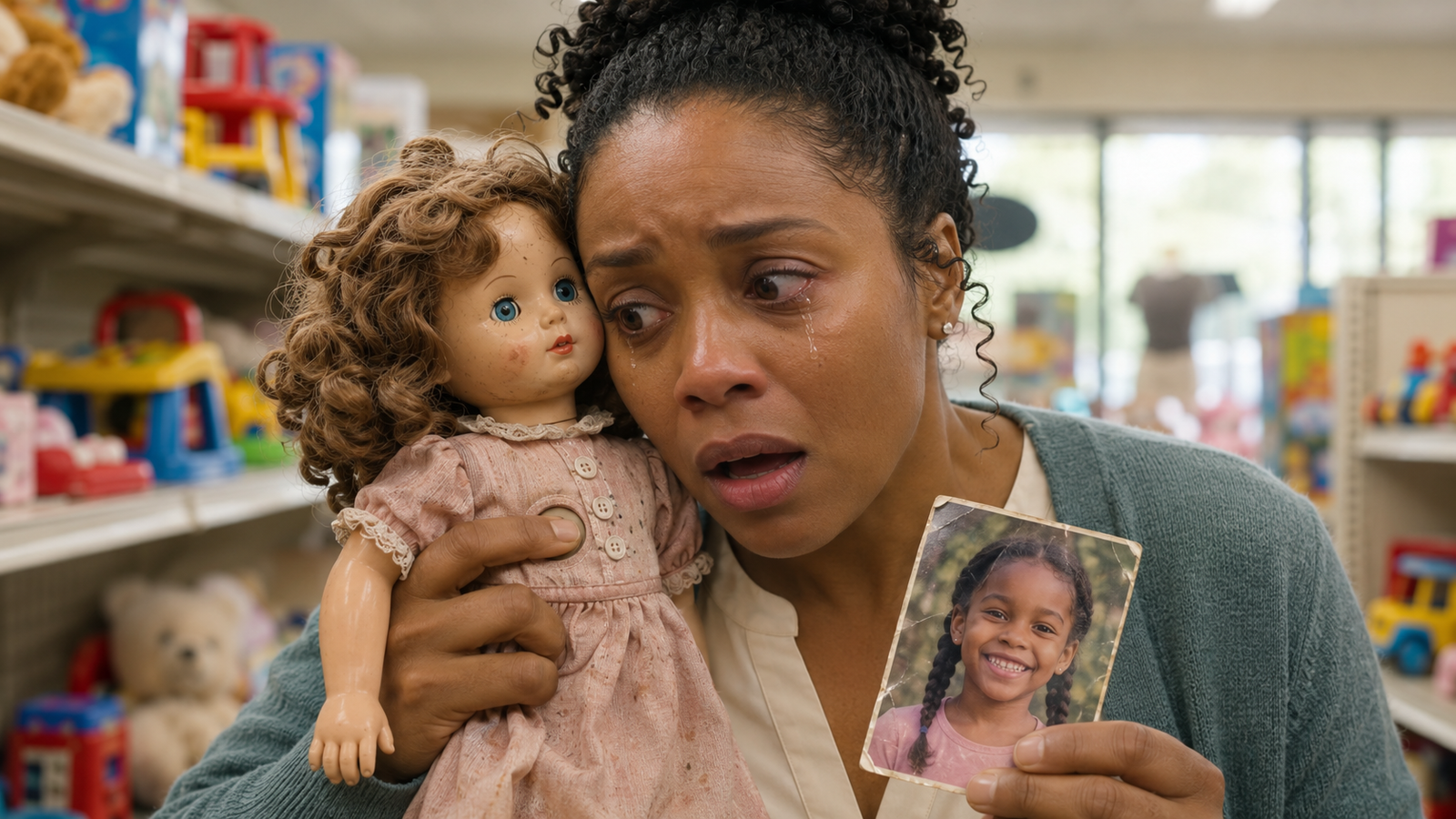
A Mother Heard Her Missing Daughter’s Voice Inside a $3 Doll — But the Child Had Disappeared Nine Months Ago!
The doll cost three dollars.
It sat on the second shelf of a small thrift store in suburban Chicago, surrounded by old toys, children’s books, and secondhand clothing.
Its pink dress was faded.
One of its shoes was missing.
And its curly brown hair was tangled.
Nobody had paid much attention to it.
Until a little boy pressed the button on its chest.
A soft electronic click followed.
Then a small girl’s voice came from inside the toy.
“Mommy… please come find me.”
Thirty-four-year-old Rebecca Wilson stopped walking.
The shopping bag slipped from her fingers.
She turned toward the shelf.
For a moment, she couldn’t breathe.
That voice.
She knew that voice.
It belonged to her seven-year-old daughter, Sophie Wilson.
But Sophie had disappeared nine months earlier.
Rebecca had searched for her every day.
She had visited police stations.
Distributed photographs.
Followed every possible lead.
And cried herself to sleep more nights than she could remember.
Now, inside an ordinary thrift store, she had just heard her missing daughter’s voice.
“Wait!”
The little boy turned.
Rebecca hurried toward him.
“Please! Play that again!”
The child looked confused.
His mother gently guided him aside as Rebecca approached the toy.
A store cashier named Emily Foster noticed the commotion.
“Ma’am, is everything okay?”
Rebecca pointed at the doll.
“That toy!”
Emily frowned.
“What about it?”
Rebecca’s hands were trembling.
“Please. I need to hear it again.”
Emily carefully picked up the doll and pressed its button.
The same recorded voice played.
“Mommy… please come find me.”
Rebecca covered her mouth.
Tears filled her eyes.
“No…”
Emily looked concerned.
“Ma’am?”
Rebecca shook her head.
“That’s Sophie.”
“Who?”
“My daughter!”
Emily glanced at the doll.
“Ma’am, it’s just an old recording toy.”
Rebecca took a breath.
“No! That’s my daughter’s voice!”
The cashier became silent.
Rebecca reached toward the doll.
“May I hold it?”
Emily nodded.
Rebecca gently took the toy.
Its fabric was worn.
The plastic face was scratched.
And a small embroidered flower decorated the collar of its pink dress.
Rebecca recognized that flower.
Her daughter had owned a doll exactly like it.
Rebecca had sewn the flower onto the dress herself.
A memory flashed through her mind.
Sophie is sitting at the kitchen table.
Laughing as Rebecca stitched the little flower.
“Now she looks like a princess, Mommy!”
Rebecca’s knees weakened.
She gripped the shelf for support.
Emily stepped closer.
“Ma’am, would you like to sit down?”
Rebecca nodded.
The cashier helped her to a chair near the register.
For several moments, Rebecca couldn’t speak.
Then Emily gently asked:
“Where is your daughter?”
Rebecca looked at the doll.
Her voice broke.
“She’s been missing for nine months.”
The cashier’s expression changed completely.
And the ordinary afternoon became the beginning of an investigation nobody in that store would ever forget.
Nine months earlier
Sophie Wilson was a cheerful seven-year-old girl who loved drawing, singing, and dressing her dolls in clothes she designed herself.
She lived with Rebecca in a modest house outside Chicago.
Rebecca worked as a medical receptionist at a neighborhood clinic.
She was a single mother, and her daughter was the center of her life.
Every morning, Sophie insisted on choosing her own clothes.
Every evening, she asked Rebecca to read the same bedtime story.
And whenever Rebecca came home from work, Sophie ran toward her with open arms.
“Mommy!”
Rebecca would laugh.
“I’m right here, sweetheart.”
Sophie always replied:
“I know! I just wanted to find you first.”
Their life wasn’t luxurious.
But it was happy.
Then, one Saturday afternoon, everything changed.
Rebecca took Sophie to a neighborhood playground.
The park was busy.
Families sat beneath the trees.
Children ran between the swings and climbing equipment.
Rebecca had arranged to meet an acquaintance nearby and was keeping an eye on Sophie while she played.
For several minutes, everything seemed normal.
Then Rebecca looked toward the swings.
Sophie was gone.
At first, she thought the girl had moved to another part of the playground.
She checked near the slides.
The benches.
The drinking fountain.
Then she began calling.
“Sophie!”
No answer.
She ran toward the far side of the park.
“SOPHIE!”
A few parents helped her search.
But nobody could find the child.
Rebecca contacted emergency services.
Police arrived.
The park was searched.
Nearby cameras were reviewed.
Witnesses were interviewed.
And by evening, Sophie’s photograph was circulating across the city.
Rebecca barely slept that night.
Or the next.
Or the next.
Weeks passed.
Searches continued.
Investigators pursued leads, but none established where Sophie had gone.
Rebecca refused to give up.
She continued working with police, providing every detail she remembered.
Then the months began passing.
Three months.
Five months.
Seven.
And finally nine.
Rebecca kept Sophie’s bedroom exactly as it had been.
Her drawings were still pinned to the wall.
Her favorite blanket remained folded on the bed.
And every evening, Rebecca sat beside the empty pillow.
“Goodnight, Sophie.”
Some nights, she cried until morning.
The doll with the embroidered flower
Sophie had always loved recording her voice.
For her seventh birthday, Rebecca bought her a secondhand talking doll.
It was a simple battery-powered toy with a recordable voice feature.
Sophie quickly became fascinated with it.
She recorded greetings.
Songs she invented.
And silly messages for her mother.
Sometimes Rebecca would enter the kitchen and hear the doll saying:
“Mommy, I love you!”
Sophie would giggle.
“Surprise!”
The doll originally wore a plain pink dress.
But Sophie wanted something special.
So Rebecca embroidered a tiny blue flower onto its collar.
After that, Sophie carried the toy almost everywhere.
She called it Rosie.
Rebecca remembered the day her daughter disappeared.
Rosie had been in Sophie’s little backpack.
And the backpack disappeared with her.
That was why the thrift-store discovery was so overwhelming.
The toy wasn’t merely similar.
The embroidered flower matched.
The missing shoe matched.
And the voice sounded unmistakably like Sophie.
Rebecca held the doll against her chest.
“Rosie…”
Emily watched quietly.
Then asked:
“Are you saying this doll belonged to your daughter?”
Rebecca nodded through tears.
“I made that little flower.”
Emily looked at the stitching.
“Are you certain?”
Rebecca showed her a photograph on her phone.
It depicted Sophie sitting on her bed, smiling while holding Rosie.
The same pink dress.
The same blue flower.
The same missing left shoe, which had disappeared shortly before the playground visit.
Emily stared at the photograph.
“Oh, my goodness.”
Rebecca looked toward her.
“Where did this doll come from?”
Emily hesitated.
“Someone donated it.”
“Who?”
“I don’t know offhand.”
Rebecca’s voice trembled.
“Please. I need to find out.”
Emily understood the urgency.
She contacted the store manager, Laura Bennett.
When Laura arrived, Rebecca explained what had happened.
She showed Sophie’s photograph.
Then played the recording again.
Laura listened in silence.
Finally, she said:
“We need to contact the police.”
Rebecca nodded.
“Please.”
The donation receipt
The store kept basic records for certain collections and scheduled donations.
Laura checked whether the doll had arrived through a documented pickup.
After reviewing the relevant store information, she found an entry associated with a recent household donation.
The item had been received with a collection of children’s toys and clothing.
The donation record included an address outside the city.
Laura didn’t give Rebecca unrestricted access to the donor’s private information.
Instead, she preserved the relevant records for the investigators.
Rebecca sat beside the counter, holding Rosie.
For the first time in nine months, she felt she had found something real.
Not a rumor.
Not an anonymous sighting.
Something she could hold.
Something that carried her daughter’s voice.
An officer arrived and carefully documented the toy.
Rebecca explained the voice recording, the blue flower, and the photograph of Sophie holding Rosie.
The doll was collected for examination using an evidence-preservation process.
Rebecca was reluctant to let go.
She held it for several seconds before handing it over.
“Please be careful with her.”
The officer nodded.
“We will.”
Investigators reviewed the donation information and began verifying the address.
That was when they discovered a name Rebecca knew.
Claire Donovan.
Rebecca’s former babysitter.
The woman who helped search
Claire Donovan was thirty-nine years old.
For nearly two years, she had occasionally looked after Sophie when Rebecca worked late.
She was friendly.
Soft-spoken.
And exceptionally attentive whenever Sophie visited.
Rebecca trusted her.
Claire sometimes helped with school pickups.
Prepared meals.
And brought small gifts for the girl.
Sophie liked her.
She called her “Miss Claire.”
When Sophie disappeared, Claire appeared devastated.
She visited Rebecca repeatedly.
Brought groceries.
Helped distribute missing-person flyers.
And attended several community search events.
She held Rebecca’s hand while she cried.
“Don’t give up,” Claire would say.
“We’ll find her.”
Rebecca had been grateful for the support.
Now investigators were telling her that the thrift-store doll had been donated from an address connected to the same woman.
Rebecca felt sick.
“Claire?”
The investigator nodded.
“We’re looking into her connection with the donation.”
Rebecca shook her head.
“She helped us search.”
The investigator explained that a donation address alone did not establish wrongdoing.
There could be innocent explanations.
But it was an important lead.
And the circumstances required careful investigation.
The second property
Investigators contacted Claire and sought to establish how the doll came into her possession.
Claire initially said she had collected several old toys from relatives.
She claimed not to remember where the doll originated.
But other details in her account raised questions.
Investigators discovered that Claire had access to another property on the outskirts of the city.
It was a modest house belonging to a relative who had relocated.
Records indicated that Claire had been regularly visiting the property.
Further evidence led investigators to seek lawful access to examine it.
Inside, officers noticed signs that part of the house was being used as a child’s living space.
There were coloring books.
Small shoes.
And children’s drawings.
Upstairs, they found a bedroom whose door was locked.
They arranged access.
When the door opened, officers discovered a little girl sitting beside a bed.
She looked frightened.
Her hair was longer than in the missing-person photographs.
She was wearing a yellow sweater.
And she was holding a coloring book.
An officer gently introduced herself.
“Hello, sweetheart.”
The girl looked up.
“Hello.”
“What’s your name?”
The child hesitated.
Then whispered:
“Sophie.”
The officer remained calm.
“Are you Sophie Wilson?”
The girl nodded.
For a moment, the officer could hardly believe what she was hearing.
After nine months, the missing child was alive.
What had happened to Sophie
The investigation revealed that Claire had taken Sophie from the playground.
Because Sophie knew her, she had initially trusted Claire enough to accompany her.
Claire then kept the child at the second property, preventing her from returning home or contacting Rebecca.
Over time, Claire attempted to convince Sophie that her mother couldn’t come for her.
She provided meals, clothing, and toys, but kept Sophie isolated from ordinary family life.
Investigators learned that Claire had become intensely attached to the idea of raising a child herself.
Rather than seeking appropriate help for her circumstances, she had made a devastating decision.
She took someone else’s daughter.
And concealed her whereabouts while helping Rebecca search.
The apparent kindness Claire showed Rebecca had allowed her to remain close to the investigation without immediately attracting suspicion.
But Sophie had never stopped asking about her mother.
And she had never forgotten Rosie.
The voice in the doll
Sophie had discovered that the doll’s recording feature still worked.
At times, when she was alone, she recorded messages.
Not because she knew anyone would hear them.
But because the doll reminded her of home.
One evening, she pressed the recording button and whispered:
“Mommy… please come find me.”
Another time, she recorded:
“I’m being good, Mommy. Please don’t forget me.”
She repeated these messages when she felt lonely.
They were a way of speaking to the mother she missed.
Eventually, Claire decided to get rid of toys associated with Sophie’s previous life.
She gathered several belongings, including Rosie, and arranged for them to be donated.
She apparently didn’t realize that the toy still contained Sophie’s recorded messages.
The doll was delivered to the thrift store.
Placed on a shelf.
And marked for sale at three dollars.
A few days later, a boy pressed its button.
And Rebecca heard the voice that changed everything.
The phone call
Rebecca was waiting at home when the investigator called.
She answered immediately.
“Hello?”
“Mrs. Wilson?”
“Yes?”
“We have an important update.”
Rebecca gripped the phone.
“Did you find something?”
The investigator paused.
“Rebecca, we’ve located a child we believe is Sophie.”
For several seconds, she couldn’t speak.
Then she whispered:
“What?”
“We’re confirming her identity and arranging a medical assessment.”
Rebecca covered her mouth.
“Is she alive?”
“Yes.”
Rebecca began crying.
The phone nearly slipped from her hand.
“Is she okay?”
“She’s receiving care. We’ll explain everything as soon as we can.”
Rebecca sank onto the sofa.
For nine months, she had imagined hearing those words.
She had rehearsed the moment in her mind.
But nothing prepared her for it.
Sophie was alive.
Her little girl was alive.
The reunion
After appropriate identity checks, medical assessment, and arrangements for Sophie’s safety, Rebecca was brought to a quiet family-support room.
She sat beside a small table.
Her hands wouldn’t stop shaking.
An officer gently explained that Sophie might feel overwhelmed.
Rebecca nodded.
“I understand.”
Then the door opened.
A little girl stepped inside with a child-support professional.
She had dark curls.
Large brown eyes.
And a shy, uncertain expression.
Rebecca stood.
For a moment, she couldn’t move.
“Sophie?”
The girl looked toward her.
Then her eyes widened.
“Mommy?”
Rebecca began sobbing.
“Oh, sweetheart.”
Sophie ran toward her.
Rebecca dropped to her knees and wrapped her arms around her daughter.
They held each other tightly.
Neither wanted to let go.
“Mommy!”
“I’m here, baby.”
Sophie began crying.
“I missed you!”
Rebecca kissed her forehead.
“I miss you every day.”
The little girl held her tighter.
“I thought you forgot me.”
Rebecca shook her head.
“Never.”
Her voice broke.
“I never stopped looking for you.”
For several minutes, they remained together.
Then Sophie asked a question.
“Did you find Rosie?”
Rebecca smiled through her tears.
“Yes, baby.”
Sophie’s expression changed.
“My doll?”
Rebecca nodded.
“That’s how we found you.”
The girl covered her mouth.
Then whispered:
“I kept talking to it.”
Rebecca looked at her.
“Why, sweetheart?”
Sophie wiped her eyes.
“Because you always told me you’d hear me if I called.”
Rebecca began crying again.
She hugged her daughter.
“And I heard you.”
The investigation continues
Claire became the subject of a criminal investigation concerning Sophie’s disappearance and confinement.
Authorities examined the events surrounding the playground, the second property, and the donation.
Evidence was collected and witnesses were interviewed.
The legal proceedings continued separately from Sophie’s recovery.
Rebecca cooperated with investigators, but her immediate priority was her daughter’s health and safety.
Sophie received support from professionals experienced in helping children after prolonged separation and frightening experiences.
Rebecca also worked with them to make the transition home as gentle as possible.
She didn’t expect Sophie to return immediately to every old routine.
Nine months had changed them both.
But one thing remained the same.
Their love.
A three-dollar miracle
Several weeks later, Rebecca returned to the thrift store.
Emily Foster was working behind the register.
When she saw Rebecca, she stopped.
“Mrs. Wilson?”
Rebecca smiled.
“Hello, Emily.”
The cashier came around the counter.
“How is Sophie?”
Rebecca’s eyes filled with tears.
“She’s home.”
Emily covered her mouth.
“Oh, thank goodness.”
Rebecca nodded.
“I wanted to thank you.”
Emily shook her head.
“I only helped contact the police.”
“You listened.”
Rebecca paused.
“And you helped preserve the one clue that brought us to her.”
Emily smiled through her tears.
The store manager, Laura, joined them.
Rebecca thanked her too.
Then she looked toward the toy shelf.
The space where Rosie had been displayed was now occupied by children’s books.
Rebecca stared at it for a moment.
“Three dollars,” she whispered.
Emily looked confused.
“What?”
Rebecca smiled sadly.
“That was the price on the doll.”
She took a breath.
“I would’ve given everything I owned to hear that voice again.”
Emily wiped her eyes.
Rebecca continued.
“But I heard her because a little boy pressed a button.”
The cashier nodded.
“Sometimes small things make a big difference.”
Rebecca smiled.
“Sometimes they change someone’s entire life.”
The voice that brought her home
Eventually, after investigators completed the necessary examination and released the doll, Rosie was returned to Sophie.
Rebecca repaired its dress.
Gently cleaned its plastic face.
And sewed a new little shoe.
But she left the blue flower exactly as it was.
One evening, Sophie sat on her bed holding Rosie.
Rebecca entered with her favorite bedtime story.
“Ready?”
Sophie smiled.
“Almost.”
She pressed the doll’s button.
A recorded child’s voice whispered:
“Mommy… please come find me.”
Rebecca felt her eyes fill with tears.
Sophie looked at her.
“That was me.”
Rebecca nodded.
“I know, sweetheart.”
The girl held out the doll.
“Can we make a new recording?”
Rebecca smiled.
“Of course.”
Sophie pressed the record button.
Then spoke clearly:
“Mommy found me.”
Rebecca began crying.
Sophie smiled.
“And now we’re home.”
Rebecca hugged her.
For nine months, the little girl had been missing.
Her mother had searched everywhere.
And the clue that finally connected investigators to her location had been sitting on a thrift-store shelf.
Waiting for someone to press a button.
The doll cost three dollars. But the voice inside it helped reunite a mother with the daughter she had never stopped searching for.
End of fictional story.