A Man Bought an Abandoned House — But Every Door He Opened Led to the Same Mysterious Bedroom!
Nathan Walker purchased the house for eighteen thousand dollars.
It had seven bedrooms, three bathrooms, an enormous kitchen and nearly two acres of land.
Nobody had lived there for eleven years.
At least, that’s what the property listing claimed.
Nathan was thirty-six years old, recently divorced, and looking for somewhere to start again.
He worked remotely as an architectural designer.
An abandoned Victorian house in rural Pennsylvania seemed like the perfect renovation project.
But there was something strange about the sale.
The real estate agent refused to enter the property.
When Nathan asked why, she gave him an uncomfortable smile.
“I’m not particularly fond of old houses.”
Nathan laughed.
“You sell houses for a living.”
“Not houses like this one.”
He assumed she was joking.
She wasn’t.
Before handing him the keys, she asked him one final question.
“Are you planning to sleep there tonight?”
Nathan nodded.
“Probably. Why?”
The woman stared at him for several seconds.
Then she handed him the keys.
“Just make sure you wake up.”
The bargain of a lifetime
The house stood at the end of a narrow country road, surrounded by enormous trees.
Its gray exterior was weathered.
Several windows were covered with wooden boards.
Dead leaves covered the front porch.
But beneath the years of neglect, Nathan could see extraordinary potential.
He parked his truck outside and took several photographs.
Then he climbed the porch steps.
The front door was dark walnut, with an oval frosted-glass window and an old brass handle.
Nathan inserted the key.
The lock turned easily.
He pushed the door open.
Inside, the house smelled of old wood and dust.
A long hallway stretched before him.
An elegant staircase stood to his left.
Several doors lined the walls.
Everything appeared exactly as it had in the property photographs.
Nathan smiled.
“Not bad for eighteen thousand.”
He placed his backpack near the entrance and began exploring.
The living room contained an abandoned fireplace.
The dining room was empty.
An old chandelier hung above the staircase.
Then Nathan approached the kitchen.
He had already studied the floor plan.
The kitchen was supposed to occupy the rear portion of the ground floor.
He opened its faded sage-green wooden door.
And stopped.
There was no kitchen.
The bedroom
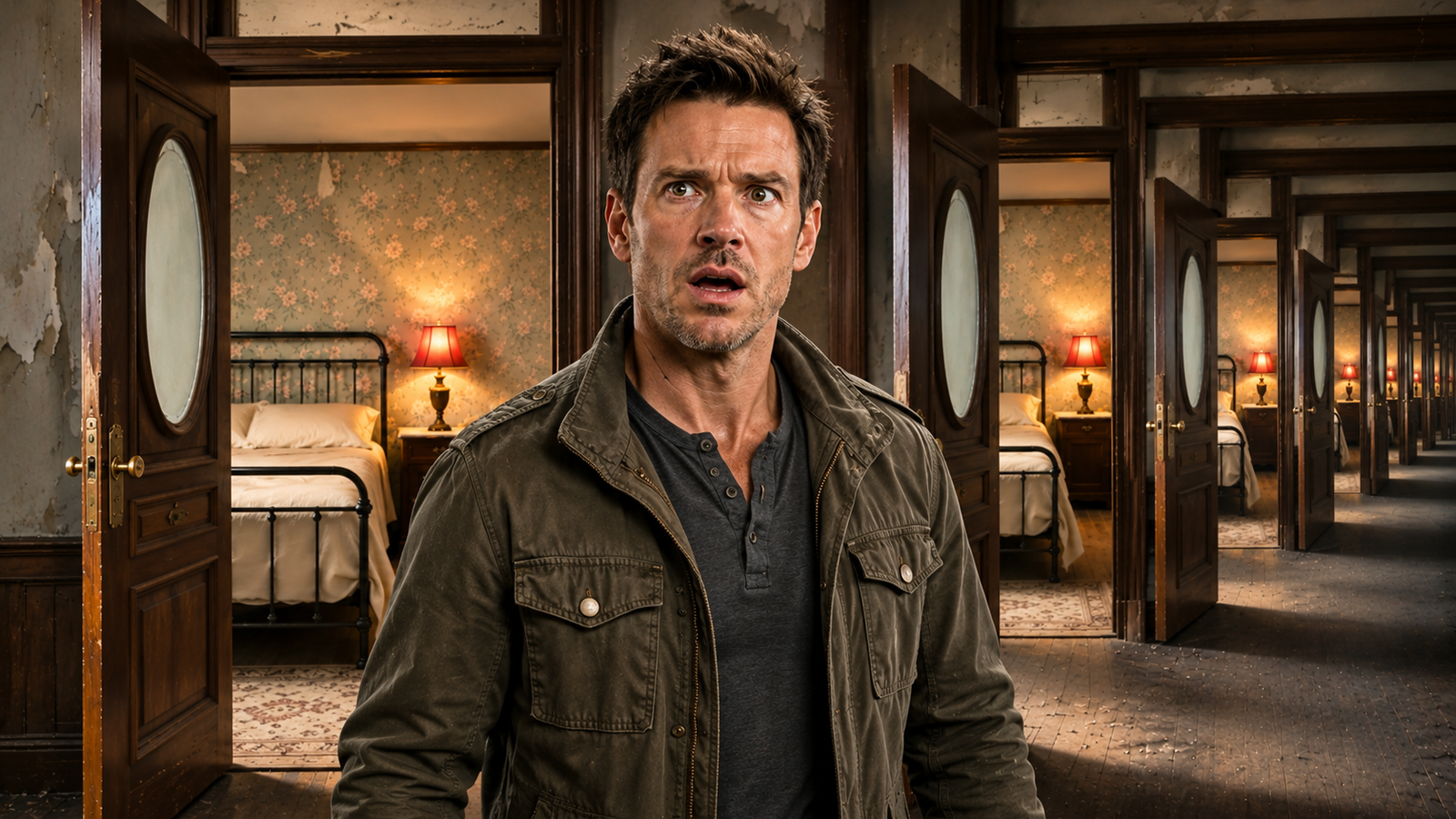
Beyond the doorway stood a small bedroom.
Faded green floral wallpaper covered its walls.
An antique black iron bed stood against the far wall.
A cream-colored blanket covered the mattress.
Beside it was a wooden nightstand with a red lampshade.
An old wardrobe stood in the corner.
The curtains were closed.
Nathan frowned.
He pulled out his phone and examined the floor plan.
According to the drawing, he was standing outside a spacious kitchen.
There should have been countertops, a sink and windows overlooking the garden.
Instead, he was looking at a bedroom.
“That’s strange.”
He took a photograph.
Perhaps the previous owners had renovated the house without updating its records.
That would explain the discrepancy.
Nathan closed the door.
He walked farther down the hallway toward the downstairs bathroom.
Its door was white, with peeling paint and a silver handle.
He opened it.
His smile disappeared.
The same bedroom stood before him.
The same wallpaper.
The same iron bed.
The same cream blanket.
The same red lamp.
Nathan looked over his shoulder.
The kitchen door was several feet away.
He looked back into the bedroom.
“No.”
He closed the bathroom door.
Then returned to the kitchen.
He opened it again.
The bedroom was still there.
He hurried back to the bathroom.
Opened its door.
The bedroom appeared again.
Nathan stood between the two entrances.
His mind searched desperately for an explanation.
Perhaps the doors connected to different sides of one room.
But the bed appeared at exactly the same angle through both entrances.
The wardrobe occupied the same corner.
Even a small tear in the wallpaper was identical.
Architecturally, it was impossible.
And Nathan understood architecture better than most people.
The experiment
Nathan decided to test what he was seeing.
He removed a blue pen from his backpack.
Entering the bedroom through the kitchen door, he placed the pen on the nightstand beside the red lamp.
Then he returned to the hallway.
He closed the kitchen door.
Walked toward the bathroom.
And opened it.
The blue pen was sitting beside the lamp.
Nathan’s stomach tightened.
He stepped inside.
Picked up the pen.
It was his.
He recognized the scratches along its plastic body.
He returned to the hallway and closed the door.
For several seconds, he stood completely still.
Then he began laughing nervously.
“This isn’t happening.”
He took out his phone.
There was no signal.
He tried calling his brother.
The call failed.
He tried again.
Nothing.
Nathan decided he had seen enough.
He would leave the property, contact the real estate agent and return with someone else.
He grabbed his backpack and hurried toward the entrance.
The front door
Nathan reached the large walnut front door.
Through its frosted-glass window, he could see pale daylight.
He grabbed the brass handle.
Pulled the door open.
And screamed.
The garden was gone.
His truck was gone.
The porch was gone.
Beyond the front door stood the bedroom.
The red lamp glowed softly.
The cream blanket remained perfectly arranged.
The curtains were closed.
Nathan stumbled backward.
He slammed the door.
Waited.
Then opened it again.
Nothing changed.
He rushed toward the living room.
Its door opened into the bedroom.
The dining room door opened into the bedroom.
The basement door opened into the bedroom.
Every door.
Every entrance.
Every possible exit.
All of them led to the same impossible place.
Nathan ran toward a hallway window.
He pulled aside its dusty curtain.
Behind the glass, he expected to see the trees surrounding the property.
Instead, he saw faded green floral wallpaper.
He stepped backward.
The house wasn’t simply preventing him from leaving.
It was gradually removing every place that wasn’t the bedroom.
The warning beneath the bed
Nathan didn’t know how long he remained in the hallway.
His phone displayed 4:17 p.m.
When he checked it again several minutes later, it still displayed 4:17.
Eventually, he approached the bedroom.
He entered cautiously.
The room was warmer than the hallway.
The red bedside lamp was illuminated, despite the electricity supposedly being disconnected.
Nathan examined the walls.
He checked behind the curtains.
There was no window.
Only wallpaper.
He examined the wardrobe.
Then he noticed something beneath the bed.
Several dark scratches marked the wooden floorboards.
Nathan crouched.
Using his phone’s flashlight, he looked underneath the iron frame.
Someone had carved words into the wood.
DON’T FALL ASLEEP.
Below the warning was another message.
THE DOORS ARE NOT REAL.
And beneath that:
IF YOU SEE YOURSELF, DO NOT WAKE HIM.
Nathan stopped breathing for a moment.
He stood abruptly.
His head struck the edge of the bedframe.
He backed toward the doorway.
“What does that mean?”
Nobody answered.
But somewhere inside the bedroom, an old clock began ticking.
Nathan couldn’t see a clock.
The previous owners
Nathan approached the wardrobe.
Its wooden doors creaked as he opened them.
Inside, there were no clothes.
Instead, dozens of photographs covered the interior walls.
They were old Polaroids.
Some had yellowed with age.
Others appeared recently developed.
Nathan removed the nearest photograph.
It showed an elderly man sleeping beneath a cream-colored blanket.
Behind him was the same green wallpaper.
The same iron bed.
The same red lamp.
Nathan examined another photograph.
A middle-aged woman.
Sleeping in the same bed.
Another showed a young man.
Another showed an elderly couple.
Every photograph depicted someone sleeping inside the bedroom.
Names and dates were written beneath them.
Robert Ellis — 1978.
Helen Morrison — 1989.
David Collins — 2003.
Rebecca Shaw — 2015.
Nathan recognized the final name.
Rebecca Shaw had been listed as the property’s previous owner.
According to the real estate agent, she had abandoned the house eleven years earlier.
Nathan looked through the remaining photographs.
Then he found one that made his hands begin trembling.
It was a photograph of himself.
He was lying beneath the cream blanket.
His eyes were closed.
He was wearing the same dark olive jacket and gray shirt he had worn that afternoon.
Written beneath the photograph was his name.
Nathan Walker — November 24, 2026.
Today’s date.
Nathan dropped the photograph.
The sound beneath the blankets
Behind him, something moved.
A soft rustling sound.
Nathan slowly turned.
The blanket on the bed was no longer flat.
There was someone underneath it.
He could see the outline of a human body.
Then he heard breathing.
Slow.
Deep.
Rhythmic.
Someone was sleeping.
Nathan stared at the bed.
He remembered the warning beneath it.
If you see yourself, do not wake him.
He wanted to leave.
But every door led back here.
He wanted to scream.
But there was nobody to hear him.
Nathan approached the bed.
His hands were shaking.
He reached toward the blanket.
Slowly, he pulled it downward.
A man’s face appeared.
Nathan froze.
It was his own face.
The same short brown hair.
The same light stubble.
The same small scar above his right eyebrow.
The sleeping man wore Nathan’s clothes.
Even the watch on his wrist was identical.
Nathan looked down at his own wrist.
Then back at the sleeping version of himself.
“No.”
He stumbled backward.
“No, no, no.”
The sleeping man’s breathing stopped.
His eyelids moved.
Then it opened.
He stared directly at Nathan.
And smiled.
“You weren’t supposed to find me yet.”
The house Nathan never entered
Nathan ran.
He rushed through the bedroom door.
And entered the bedroom again.
He turned around.
Opened another door.
The bedroom.
Again.
Again.
Again.
The sleeping version of himself was now sitting upright on the bed.
“Stop running,” the man said.
Nathan pressed himself against the wall.
“Who are you?”
The man tilted his head.
“You already know.”
“What is this place?”
The man looked toward the wardrobe.
“A room that remembers.”
Nathan shook his head.
“I bought a house.”
“No.”
“I drove here. I opened the front door.”
The man smiled.
“Did you?”
Suddenly, Nathan remembered something.
The long drive.
The country road.
The exhaustion.
He remembered pulling into the driveway.
He remembered looking at the house through his truck’s windshield.
But then his memories became strangely incomplete.
Had he actually stepped out of the truck?
Had he climbed the porch?
Had he inserted the key?
Or had he simply imagined doing those things?
The man on the bed pointed toward the red lamp.
“You fell asleep before you entered.”
Nathan stared at him.
“Then I’m dreaming?”
The man shook his head.
“Not anymore.”
The man in the truck
The following morning, a local delivery driver noticed a truck parked outside the abandoned Victorian house.
Its engine was off.
A man was sitting behind the steering wheel.
His head rested against the window.
The driver knocked.
There was no response.
He contacted emergency services.
When responders arrived, they found Nathan Walker unconscious inside his vehicle.
His vital signs were stable.
There were no obvious injuries.
The keys to the house rested on the passenger seat.
The property remained locked.
Nathan’s footprints were absent from the dusty front porch.
His backpack was still inside the truck.
There was no evidence that he had ever entered the house.
Nathan was transported to a hospital.
Hours passed.
Then days.
Doctors could not establish why he remained unconscious.
His brain activity suggested he was experiencing unusually persistent dream states.
Occasionally, he spoke while sleeping.
One nurse heard him whisper:
“That’s the same room.”
Another heard him say:
“Please open the front door.”
He never woke up.
The new photograph
Three weeks later, the real estate agent returned to the abandoned property.
She stood outside the front entrance.
For a long time, she did not move.
Then she unlocked the door.
Inside, the house appeared ordinary.
The kitchen was a kitchen.
The bathroom was a bathroom.
The living room was empty.
She climbed the staircase and approached a small bedroom at the end of the upstairs hallway.
She opened its door.
Faded green wallpaper.
An antique iron bed.
A cream blanket.
A red bedside lamp.
An old wardrobe.
The bed was empty.
The woman opened the wardrobe.
She examined the photographs.
There was a new one.
Nathan Walker.
Sleeping peacefully beneath the cream blanket.
The agent closed her eyes.
“Another one.”
She shut the wardrobe.
Turned off the lamp.
And left the house.
The following week, a new property listing appeared online.
Seven bedrooms.
Three bathrooms.
Nearly two acres of land.
Asking price: twelve thousand dollars.
Somewhere behind the door
Nathan was still running.
He had stopped counting how many times he opened the doors.
Sometimes the bedroom was empty.
Sometimes his duplicate was sleeping.
Sometimes the duplicate stood beside the wardrobe, examining photographs.
Nathan no longer knew which version of himself was real.
He approached the front door one final time.
He grabbed the handle.
Closed his eyes.
And whispered:
“Please let me wake up.”
He opened it.
The red lamp was waiting.
From beneath the cream blanket, his own voice whispered:
“Welcome home, Nathan.”
He had never really entered the house.
But something inside the house had entered his dreams.
And it wasn’t letting him wake up.
End of fictional story.