Every Night, an Empty Elevator Arrived at a Floor That Didn’t Exist — Until a Security Guard Decided to Investigate!
Marcus Reed had worked the night shift at the Westbridge Financial Center for nearly eight months.
It was an uncomplicated job.
Monitor the security cameras.
Patrol the empty corridors.
Check the entrances.
Make sure nobody enters the building after business hours.
The twelve-story office building stood in downtown Cleveland, Ohio.
During the day, hundreds of employees filled its offices.
At night, Marcus was usually alone.
He was forty-two years old, a former security supervisor who preferred quiet environments and predictable routines.
Nothing about the Westbridge Financial Center had ever frightened him.
Until one Tuesday night.
At exactly 2:17 a.m., Marcus heard an elevator bell.
He looked up from his security desk.
The elevator was moving.
That was unusual.
The building had been empty for hours.
But what appeared on the elevator’s digital display made him question everything he knew about the place.
The number changed from 11 to 12.
Then from 12 to 13.
Marcus stared at it.
There was no thirteenth floor.
The Impossible Number
Marcus stood from his chair.
He approached the elevator bank and looked directly at the illuminated display.
The red number remained unchanged.
13.
He knew the building’s layout perfectly.
Twelve floors.
A basement containing mechanical equipment.
A rooftop accessible only through a locked maintenance staircase.
There was no hidden executive level.
No additional floor.
No unfinished construction above the twelfth story.
Marcus assumed the display was malfunctioning.
He returned to his security desk and opened the elevator’s internal camera feed.
The cabin was empty.
Its fluorescent ceiling lights were illuminated.
Nothing appeared unusual.
Then the camera feed briefly distorted.
For several seconds, the screen displayed static.
When the picture returned, the elevator doors were open.
Beyond them was complete darkness.
Marcus leaned closer to the monitor.
Something moved near the edge of the image.
Before he could identify it, the elevator doors closed.
The display began counting downward.
13.
12.
11.
10.
Eventually, the elevator reached the lobby.
Its bell rang.
The stainless-steel doors opened.
Marcus approached cautiously.
Nobody stepped out.
But someone had left something behind.
The Muddy Footprints
Fresh muddy footprints covered the elevator floor.
Marcus stopped outside the cabin.
The footprints began near the rear wall and continued toward the entrance.
They appeared to belong to an adult wearing ordinary shoes.
But the elevator had been empty.
Marcus had watched the camera feed himself.
Nobody had entered.
Nobody had exited.
He examined the lobby floor.
There were no footprints outside the elevator.
They ended abruptly at the threshold.
Marcus photographed them with his phone.
Then he called his supervisor, Harold Bennett.
Harold answered after several rings.
“Marcus? What’s wrong?”
“Does this building have a thirteenth floor?”
Harold was silent.
“No.”
“Then we’ve got a problem with elevator number two.”
“What kind of problem?”
“It just went to thirteen.”
Another silence.
Longer this time.
“Listen carefully,” Harold finally said.
“Don’t use that elevator tonight.”
Marcus frowned.
“Should I call maintenance?”
“No. I’ll handle it tomorrow.”
“There are muddy footprints inside.”
Harold interrupted him.
“Marcus, close the elevator and return to your desk.”
The call ended.
Marcus looked at his phone.
His supervisor hadn’t asked for photographs.
He hadn’t questioned whether Marcus was mistaken.
He had simply told him to stay away.
Almost as though he already knew.
The Previous Security Guard
The following afternoon, Marcus arrived early for his shift.
He found Harold speaking with a maintenance technician beside the elevator.
The technician examined the control panel.
After several minutes, he shook his head.
“Everything looks normal.”
Marcus showed him the photograph of the digital display.
The technician studied it.
“That shouldn’t be possible.”
“That’s what I thought.”
“The system isn’t programmed for thirteen floors.”
Harold quickly ended the conversation.
He told Marcus the problem had been resolved and instructed him to continue his normal duties.
But Marcus wasn’t satisfied.
Later that evening, he spoke with an elderly cleaning employee named Evelyn.
She had worked in the building since it opened.
Marcus asked whether she had ever noticed anything unusual about the elevators.
Evelyn stopped wiping the reception counter.
“Which elevator?”
“Number two.”
Her expression changed.
“Has it started again?”
Marcus stared at her.
“What do you mean, again?”
Evelyn glanced toward the security cameras.
“The man who worked your shift before you used to talk about it.”
Marcus knew very little about his predecessor.
He had been told the previous guard resigned unexpectedly.
“What happened to him?”
Evelyn lowered her voice.
“He went upstairs one night.”
“And?”
“He never came back.”
Marcus waited for her to laugh.
She didn’t.
The Building That Came Before
During his next patrol, Marcus searched the building’s administrative records.
The Westbridge Financial Center had opened in 1994.
But the property itself had a much longer history.
An old newspaper photograph showed a large brick hospital occupying the same location.
St. Augustine Memorial Hospital.
The hospital had operated for nearly sixty years before closing in 1987.
Marcus searched historical newspaper archives on his phone.
Most articles described declining funding, outdated facilities and administrative problems.
But one report caught his attention.
It concerned an unexplained incident involving the hospital’s psychiatric observation ward.
The article mentioned missing patient records, an emergency evacuation and an ongoing investigation.
The final paragraph stated that several hospital employees had been unable to account for a number of patients.
Marcus searched for the investigation’s outcome.
He found nothing.
No follow-up articles.
No official explanation.
The hospital had been demolished several years later.
The financial center had been constructed over its foundations.
Marcus looked toward the elevator.
For the first time, he wondered whether the impossible floor belonged to something that had existed before the building.
The Second Night
At 2:17 a.m., the elevator bell rang again.
Marcus immediately checked the display.
12.
Then 13.
He watched the camera feed.
The elevator cabin was empty.
The screen distorted.
The doors opened into darkness.
Then closed.
When the elevator returned to the lobby, the muddy footprints had reappeared.
Marcus felt a cold sensation travel down his spine.
He remembered Harold’s warning.
He remembered Evelyn’s story about the missing guard.
Every sensible part of his mind told him to stay away.
But he needed to know what was happening.
He activated his body camera.
Placed his phone in his pocket.
And stepped inside the elevator.
The doors closed behind him.
Marcus examined the control panel.
The buttons were numbered from 1 through 12.
There was no button marked 13.
He pressed 12.
The elevator began moving.
Beyond the Twelfth Floor
Marcus watched the illuminated numbers.
8.
9.
10.
11.
12.
He expected the elevator to stop.
It didn’t.
The cabin continued rising.
Marcus looked at the control panel.
The twelfth-floor button was no longer illuminated.
He pressed the lobby button.
Nothing happened.
He pressed the emergency call button.
A burst of static came through the speaker.
Then silence.
The digital indicator changed.
13.
The elevator stopped.
For several seconds, the doors remained closed.
Marcus could hear something on the other side.
A distant metallic rattling.
Then the doors slowly separated.
He raised his flashlight.
And stared.
The Forgotten Hospital
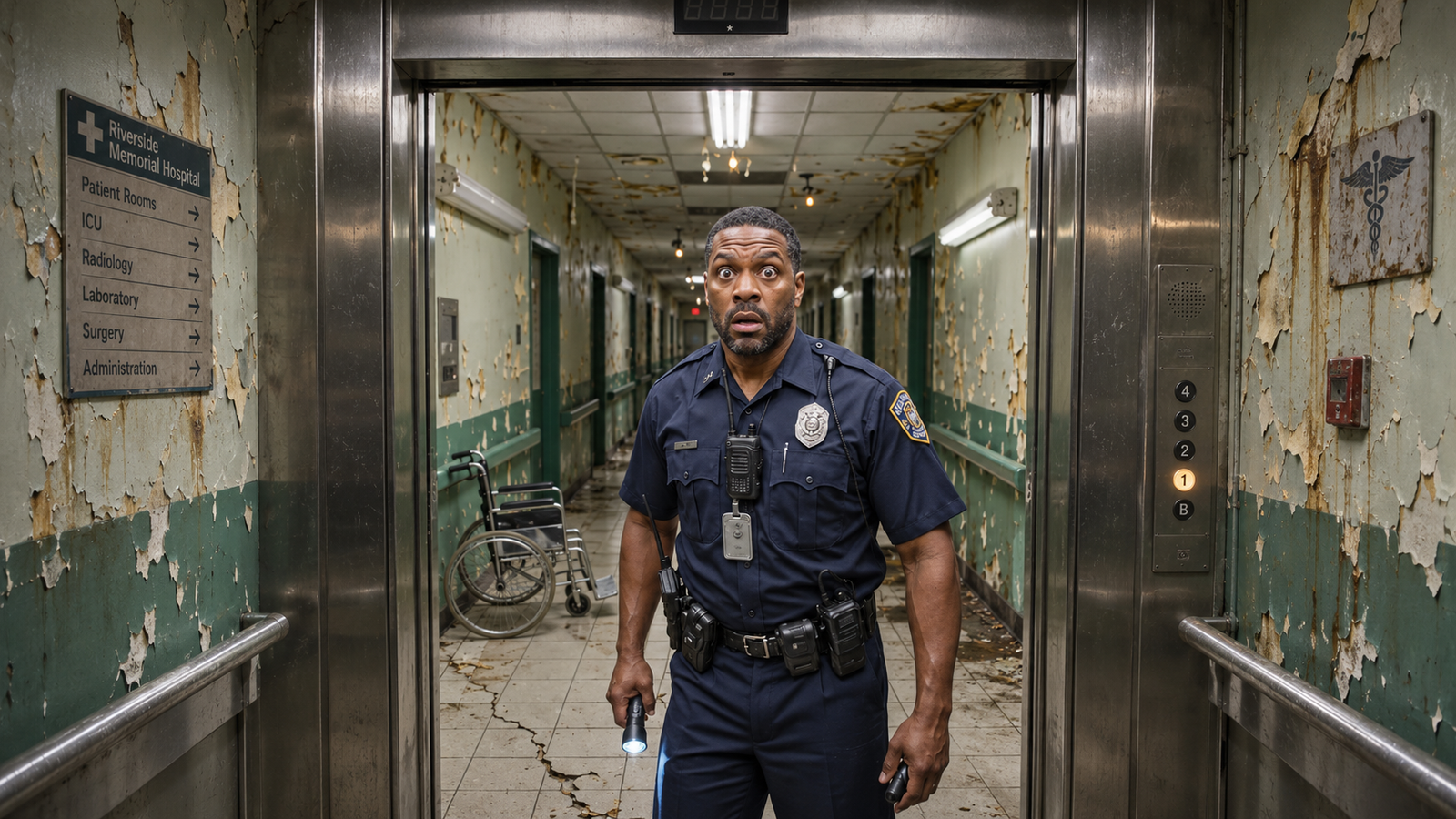
Beyond the elevator stood an abandoned hospital corridor.
The walls were painted a faded institutional green.
Large sections of paint had peeled away.
Old fluorescent lights flickered overhead.
A rusted wheelchair stood beside an open doorway.
An overturned medical trolley rested against the opposite wall.
A faded sign hung from the ceiling.
ST. AUGUSTINE MEMORIAL HOSPITAL — OBSERVATION WARD.
Marcus couldn’t move.
The hospital had been demolished decades earlier.
Yet here it was.
Not a photograph.
Not a reconstruction.
A real corridor stretching into darkness.
He could smell damp plaster, disinfectant and something metallic.
Marcus looked behind him.
The elevator remained open.
He should have returned immediately.
Instead, he stepped into the corridor.
“Hello?”
His voice echoed through the abandoned ward.
Nobody answered.
Then, somewhere in the distance, a telephone began ringing.
The Nurses’ Station
Marcus followed the sound.
He discovered an old nurses’ station containing dusty medical equipment, paper charts and a beige telephone.
The telephone stopped ringing as he approached.
A wall calendar displayed October 1987.
Beside it hung a clock.
Its hands were frozen at 2:17.
Marcus removed his phone.
The screen displayed the current date.
But there was no signal.
He attempted to record the nurses’ station.
His camera showed only a black screen.
He tried his body camera.
Its indicator light had stopped flashing.
Marcus looked around.
Everything appeared to belong to another time.
There were no modern computers.
No contemporary medical devices.
Even the newspapers on the counter were decades old.
Then he noticed a handwritten note beside the telephone.
NIGHT SECURITY — DO NOT ANSWER CALLS FROM ROOM 47.
Marcus read it twice.
Why would a hospital leave instructions specifically for night security?
He turned toward the corridor.
A door stood at its far end.
Above it was a metal number.
47.
The Patient Records
Marcus discovered a filing room behind the nurses’ station.
Hundreds of patient folders filled its shelves.
Most were covered in dust.
He removed one at random.
The documents inside were dated 1987.
The patient’s photograph was attached to the front page.
Marcus opened another folder.
Then another.
Each contained medical observations, admission forms and personal information.
One unusual detail appeared repeatedly.
Several patients had been admitted at precisely 2:17 a.m.
Their discharge dates were blank.
Marcus continued searching.
Near the bottom of a filing cabinet, he discovered a folder that looked newer than the others.
Its label read:
PATIENT 47 — REED, MARCUS.
He stopped breathing.
Slowly, he opened it.
His own photograph stared back at him.
It was recent.
He was wearing his current security uniform.
The document listed his full name.
His date of birth.
His home address.
His employment history.
Everything was correct.
But the admission date was tomorrow.
Marcus dropped the folder.
“This isn’t possible.”
He backed away from the cabinet.
Then he noticed another document inside.
It contained a photograph of him standing in the hospital corridor.
The photograph showed him holding the exact same flashlight.
It had apparently been taken only moments earlier.
Yet nobody had been there.
The Missing Guard
Marcus searched the cabinet again.
He found a folder belonging to a man named Thomas Keller.
The photograph showed a middle-aged security guard wearing a Westbridge Financial Center uniform.
Marcus recognized him from an old employee identification photograph.
His predecessor.
The man Evelyn claimed had disappeared.
Thomas’s admission date was eight months earlier.
His patient number was 46.
A handwritten note appeared at the bottom of his file.
PATIENT REMAINS IN OBSERVATION.
Marcus heard something behind him.
A soft scraping sound.
He turned.
A man stood at the filing-room entrance.
His security uniform was dirty and faded.
His face was pale.
His eyes looked exhausted.
Marcus immediately recognized him.
“Thomas?”
The man stared at Marcus’s uniform.
“You’re the new guard.”
Marcus nodded.
“What happened to you?”
Thomas glanced toward the corridor.
“You shouldn’t have come here.”
“Everyone thinks you resigned.”
Thomas gave a hollow laugh.
“I wish I had.”
Marcus stepped closer.
“How long have you been here?”
Thomas looked confused.
“Three nights.”
Marcus shook his head.
“You’ve been missing for eight months.”
Thomas’s expression collapsed.
For several seconds, neither man spoke.
Then Thomas whispered:
“It doesn’t let time work properly.”
The Announcement
A loud crackle came from an old speaker mounted near the ceiling.
Marcus and Thomas looked upward.
A woman’s distorted voice echoed throughout the ward.
“Patient 47 has returned. Please secure all exits.”
Marcus felt his stomach tighten.
Thomas grabbed his arm.
“Run.”
They hurried toward the elevator.
The fluorescent lights began switching off behind them.
One after another.
The corridor grew darker.
Marcus could see the open elevator doors ahead.
He ran faster.
But as they approached, the elevator’s interior lights went out.
The stainless-steel doors disappeared into darkness.
Marcus stopped.
There was no elevator.
Only a solid hospital wall.
He pressed his hands against it.
“No!”
Thomas pulled him away.
“Don’t let them find you in the corridor.”
“Who?”
Thomas looked toward the darkness.
“The people who still think this hospital is open.”
A wheelchair began moving somewhere behind them.
Neither man could see who was pushing it.
The Truth About Room 47
Thomas led Marcus into an abandoned patient room.
He closed the door.
Then he explained what he had discovered during his time inside the hospital.
In 1987, the observation ward had been involved in an unauthorized experimental treatment program.
Patients suffering from severe sleep disorders had been subjected to prolonged periods of isolation.
The program’s director, Dr. Leonard Voss, believed that human consciousness could become detached from ordinary perceptions of time.
According to documents Thomas had discovered, the experiments became increasingly unpredictable.
Patients reported seeing hospital corridors that didn’t exist.
Staff members claimed to encounter people who had not yet been admitted.
Clocks stopped.
Telephones rang from disconnected rooms.
Then, one night, an entire section of the observation ward disappeared from the hospital’s accessible floor plan.
The incident occurred at 2:17 a.m.
Authorities evacuated the remaining hospital.
The experimental ward was never recovered.
The building was eventually demolished.
“But this place is still here,” Marcus whispered.
Thomas nodded.
“Not exactly here.”
He pointed toward the ceiling.
“Somewhere between when it existed and when it stopped existing.”
Marcus remembered his patient file.
“Why does it know my name?”
Thomas looked at him.
“Because it was waiting for you.”
The Security Supervisor
Marcus remembered Harold’s reaction to the elevator display.
He remembered how quickly his supervisor had told him to stay away.
“Harold knows about this.”
Thomas nodded.
“He knew before I came here.”
Thomas explained that the building’s management had received reports of unusual elevator activity for years.
Most incidents were dismissed as technical malfunctions.
But several employees had disappeared.
The company had concealed the connection between those disappearances and elevator number two.
Harold had attempted to prevent further incidents by warning night guards never to investigate.
But nobody had understood why the elevator kept returning.
Thomas believed the hospital was attempting to replace the patients it had lost in 1987.
Every new arrival received a patient number.
Every patient was recorded.
And once the admission process was completed, the hospital no longer allowed them to leave.
Marcus looked at the date on his file.
Tomorrow.
His admission had not yet been completed.
There was still time.
The Original Patient
Marcus and Thomas returned to the filing room.
They searched through the oldest records.
Eventually, Marcus discovered the original folder marked Patient 47.
It belonged to a man named Samuel Reed.
Marcus recognized the name immediately.
Samuel was his father.
His father had died when Marcus was a teenager.
He rarely spoke about his early life.
Marcus had never known that Samuel had been admitted to St. Augustine Memorial Hospital.
The folder contained a handwritten statement.
Samuel had participated in the experimental program in 1987.
On the night the ward disappeared, he had escaped before his scheduled admission procedure was completed.
The hospital’s records still listed him as an outstanding patient.
Marcus turned another page.
A newer document had been attached.
ORIGINAL PATIENT DECEASED.
REPLACEMENT IDENTIFIED.
MARCUS REED.
Marcus stared at the words.
The hospital hadn’t chosen him randomly.
It had been waiting for someone connected to the patient who escaped.
His employment at the financial center had brought him directly above the place where his father had disappeared from its records.
And now it wanted to finish what it had started.
The Final Discharge
Thomas discovered something important in the original hospital records.
The experimental ward operated according to a rigid administrative routine.
Patients were admitted.
Observed.
Transferred.
Discharged.
But none of the remaining patients had completed the final stage.
Their records had remained open since 1987.
Marcus realized that the hospital’s strange behavior was connected to those unfinished records.
He found his father’s original discharge authorization.
It had been signed by a physician shortly before the disappearance.
But it had never been entered into the ward’s central register.
Marcus carried the document to the nurses’ station.
Thomas followed.
The overhead speaker crackled again.
“Patient 47, report for admission.”
Marcus opened the enormous patient register.
He found Samuel Reed’s name.
Beside it was an empty discharge field.
He placed the signed authorization against the page.
The lights flickered violently.
The hospital intercom fell silent.
For the first time, the clock above the nurses’ station moved.
2:18.
Then 2:19.
A telephone rang.
Thomas stared toward the corridor.
At its far end, a familiar elevator bell sounded.
The Return
The stainless-steel elevator doors had reappeared.
Marcus and Thomas ran toward them.
The doors opened.
Inside was the modern elevator cabin.
Marcus recognized its polished metal walls and digital control panel.
They stepped inside.
Thomas pressed the lobby button.
The doors closed.
For several seconds, the elevator remained motionless.
Then it began descending.
13.
12.
11.
10.
Marcus held his breath.
When the doors finally opened, they were back in the financial center’s lobby.
Harold stood beside the security desk.
His face turned pale when he saw Thomas.
“Where have you been?”
Thomas looked at Marcus.
Neither man knew how to answer.
Marcus checked the clock.
It was 2:20 a.m.
Only three minutes had passed.
The Investigation
Authorities investigated Thomas’s disappearance after his unexpected return.
Medical examinations revealed severe exhaustion and dehydration.
But doctors could not explain why a man missing for eight months appeared to have aged only a few days.
Marcus provided the photographs and patient records he had carried from the hospital.
Most of the photographs were corrupted.
The documents, however, were real.
Historical researchers confirmed that Samuel Reed had been a patient at St. Augustine Memorial Hospital.
They also confirmed that several original patient records had disappeared in 1987.
The financial center temporarily closed.
Elevator number two was permanently removed from service.
Marcus resigned.
Thomas returned to his family.
For several weeks, nothing unusual happened.
Marcus began believing that the hospital had finally released them.
Then a letter arrived at his home.
The Fourteenth Floor
The envelope contained no return address.
Inside was a single hospital document.
ST. AUGUSTINE MEMORIAL HOSPITAL.
PATIENT 47 — DISCHARGED.
Marcus felt an overwhelming sense of relief.
But another sheet of paper was attached.
It was an employee assignment form.
His photograph appeared at the top.
MARCUS REED — NIGHT SECURITY.
ASSIGNED LOCATION: FLOOR 14.
REPORTING TIME: 2:17 A.M.
Marcus dropped the document.
That night, he woke to the sound of an elevator bell.
He lived in a single-story house.
There was no elevator.
He walked toward his bedroom door.
A faint red light appeared beneath it.
From the other side, a familiar mechanical voice announced:
“Fourteenth floor.”
Marcus stepped backward.
The hospital had discharged him as a patient.
But apparently, it had found another reason to bring him back.
End of fictional story.