
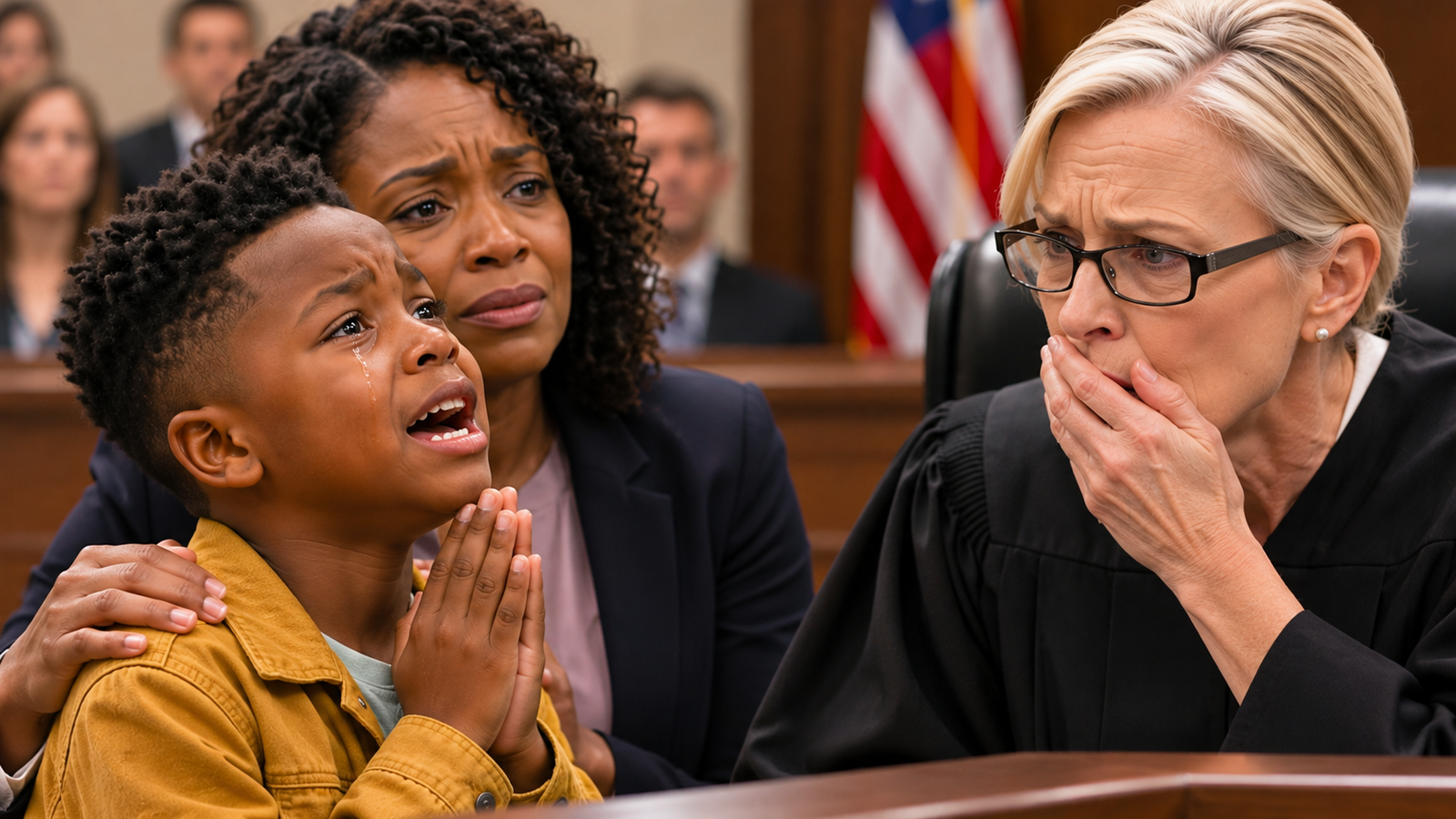
A Little Boy Begged the Judge Not to Release His Father — But His Terrifying Reason Silenced the Courtroom!
The courtroom fell silent when the judge announced her decision.
“Mr. Bennett, the court has approved your release on bail, subject to the conditions just explained.”
Thirty-nine-year-old Michael Bennett stood beside his attorney.
He was exhausted.
His face looked pale.
And for the first time in nearly two weeks, he felt hopeful.
He was going home.
Or at least, that was what he believed.
Then a small voice erupted from the public seating area.
“NO!”
Everyone turned.
A ten-year-old boy stood beside his mother.
His name was Oliver Bennett.
And he was staring directly at his father.
“PLEASE DON’T LET MY DADDY OUT!”
The entire courtroom froze.
Michael turned toward his son.
“Oliver?”
The boy’s eyes filled with tears.
“Please, Your Honor!”
His mother, Emily Bennett, gently placed a hand on his shoulder.
“Oliver, sweetheart—”
But the boy shook his head.
“No, Mom!”
Michael felt his heart breaking.
For twelve days, he had imagined the moment he would finally see his family again.
He had spent every night thinking about Oliver.
About helping him with his homework.
Watching their favorite baseball games.
And sitting together at the kitchen table.
Now his own child was begging a judge not to let him come home.
Michael swallowed.
“Son, why would you say that?”
Oliver looked toward his father.
His lips trembled.
“Because they’re waiting for you.”
Michael froze.
“What?”
The boy lowered his eyes.
“They said something bad would happen if you came home.”
A quiet murmur spread through the courtroom.
The judge, Honorable Patricia Coleman, raised her hand.
“Everyone, please remain quiet.”
She looked toward Oliver.
“Young man, what is your name?”
“Oliver Bennett.”
“Oliver, I understand you’re worried. Can you tell us why?”
The boy hesitated.
Then he reached into his jacket pocket.
He removed a folded photograph.
His hands trembled as he held it up.
“I took this outside our house this morning.”
The judge looked toward a court officer.
“Please bring that to counsel so we can examine it appropriately.”
Oliver passed the photograph to his mother, who gave it to the officer.
After both sides had an opportunity to review it, the photograph was presented to the judge.
She looked down.
Her expression changed.
Two unfamiliar men were standing near the Bennett family’s driveway.
One was beside a dark SUV.
The other was watching the front entrance.
Judge Coleman looked toward the prosecutor.
“Have these individuals been identified?”
The prosecutor shook his head.
“Not at this time, Your Honor.”
The judge examined the photograph again.
Then she asked:
“Oliver, do you know who these two men are?”
The boy began crying.
“No.”
“Have you seen them before?”
He nodded.
“Three times.”
Michael looked stunned.
“Three times?”
Oliver nodded.
“They’ve been outside our house since Dad was arrested.”
Judge Coleman leaned forward.
“Did they speak to you?”
Oliver hesitated.
Then whispered:
“They spoke to Mommy.”
Emily covered her mouth.
Michael turned toward his wife.
“Emily?”
Her eyes filled with tears.
She had been trying to protect Oliver from everything happening around them.
But now the secret was out.
The family hadn’t simply been dealing with Michael’s arrest.
They had been receiving frightening visits from strangers.
And Oliver believed those strangers were waiting for his father to return.
To understand why, the investigators needed to examine what had happened two weeks earlier.
Michael Bennett had worked as a senior accountant for Harrison Construction Group, a major regional building company, for more than twelve years.
He wasn’t wealthy.
He lived in a modest suburban home with Emily and Oliver.
He drove an aging sedan.
And most evenings, he returned home carrying folders of work he hadn’t finished at the office.
But he loved his family.
And he took his job seriously.
Michael believed his responsibility was simple.
Make sure the company’s financial records were accurate.
Then one afternoon, he discovered something unusual.
A series of payments had been issued to subcontractors that didn’t appear in the company’s approved project records.
At first, he assumed it was a bookkeeping error.
But when he compared the invoices, he found repeated discrepancies.
Several payments had been made to businesses with unusually similar addresses.
Others carried descriptions that didn’t correspond to completed construction work.
And some had been approved outside normal company procedures.
Michael began asking questions.
His supervisor told him not to worry.
“Those are executive-level expenses.”
Michael frowned.
“Then why are they being recorded as subcontractor payments?”
His supervisor shrugged.
“That’s above your pay grade.”
But Michael wasn’t satisfied.
He documented the irregularities and requested clarification.
Then he discovered that several of the suspicious transactions had been authorized through accounts controlled by the company’s chief executive, Richard Harrison.
Michael became concerned.
He prepared a formal report for the company’s audit committee.
He also sought independent legal advice about how to raise the concerns appropriately.
But before the committee could fully review his report, something unexpected happened.
Company security officials arrived at his desk.
They said he was being investigated for financial misconduct.
Michael was stunned.
“What?”
They showed him transaction records indicating that funds had been diverted through an account linked to his employee credentials.
Michael shook his head.
“That’s impossible.”
His supervisor looked at him coldly.
“Mr. Harrison believes you’ve been stealing from the company.”
Michael stared at him.
“I reported suspicious payments last week!”
But his protests changed nothing.
The company filed a criminal complaint.
Investigators began reviewing the allegations.
And Michael was arrested after evidence was submitted suggesting he had participated in the unauthorized transfers.
He maintained his innocence.
His attorney argued that the records needed independent forensic examination.
But while the case was being investigated, Michael remained in custody pending a bail decision.
At home, Emily tried to explain everything to Oliver.
“Daddy is dealing with a difficult problem,” she told him.
“Did he do something bad?”
“No, sweetheart. He says he didn’t.”
“Then why can’t he come home?”
Emily hugged him.
“His lawyer is working on it.”
Oliver nodded.
But he was frightened.
Then the visits began.
The first time, a dark SUV parked across the street.
Two men sat inside for almost an hour.
Emily noticed them through the front window.
When she stepped outside, the vehicle drove away.
The next day, the same SUV returned.
This time, one of the men approached the house.
Emily opened the front door cautiously.
“Can I help you?”
The man looked toward the hallway behind her.
“Mrs. Bennett?”
“Yes?”
“We’d like to talk about your husband’s situation.”
Emily frowned.
“Who are you?”
The man gave a vague answer.
He said he was associated with people who wanted Michael to stop making accusations about his employer.
Emily’s stomach tightened.
“What do you mean?”
The stranger lowered his voice.
“Your husband should understand that some matters are better left alone.”
Emily stepped backward.
“Please leave.”
The man looked at her.
“Just tell him to be careful.”
Then he walked away.
Emily immediately contacted Michael’s attorney and reported the encounter.
The lawyer advised her to preserve any evidence and report the matter to law enforcement.
She did.
But the men returned.
On the morning of Michael’s bail hearing, Oliver saw the dark SUV again.
He was standing beside his bedroom window when it stopped near the driveway.
Two men stepped out.
One looked toward the house.
The other spoke into a phone.
Oliver remembered what his mother had told the police.
He quietly took his tablet and photographed the men through the window.
Then he ran downstairs.
“Mom!”
Emily turned.
“What’s wrong?”
“They’re back!”
She hurried toward the window.
The SUV was already leaving.
Oliver showed her the photograph.
Emily felt her heart tighten.
“We need to send that to Daddy’s lawyer.”
Oliver nodded.
But as they prepared to leave for court, he asked a question.
“Mom?”
“Yes, sweetheart?”
“What happens when Dad comes home?”
Emily hesitated.
“We’ll be together again.”
Oliver looked frightened.
“But those men know where we live.”
She knelt beside him.
“We’re going to tell the police what happened.”
Oliver shook his head.
“What if they’re waiting for him?”
Emily hugged him.
She wanted to promise nothing bad could happen.
But she couldn’t honestly know that.
So she told him:
“We’ll make sure the judge and the police know about the photograph.”
At the courthouse, Oliver sat quietly through the proceedings.
He listened as the attorneys discussed the case.
Then the judge announced that his father could be released on bail.
Most children would have been relieved.
Oliver was terrified.
He imagined Michael walking toward their house.
He pictured the dark SUV returning.
And he remembered the stranger’s warning.
That was why he stood up.
That was why he begged the judge not to let his father leave.
Not because he was afraid of Michael.
But because he was afraid for him.
Back in the courtroom, Judge Coleman reviewed the photograph and listened to the family’s account.
She then allowed counsel to address the new safety concern.
The prosecutor confirmed that reports about the suspicious visitors had been submitted.
Michael’s attorney asked the court to consider protective arrangements before his client’s release.
The judge took the matter seriously.
“The court will not rely on a child’s fear alone to determine guilt or innocence,” she explained. “But credible concerns about threats must be investigated.”
The court briefly recessed while the parties coordinated with law enforcement.
Investigators obtained Oliver’s original photograph and reviewed available security-camera footage from the neighborhood.
They identified the SUV.
They traced its registration.
And they began examining the men who had been visiting the Bennett home.
The investigation uncovered a troubling connection.
Both men had recently performed private security work for a contractor associated with Harrison Construction Group.
Further inquiries established that they had communicated with individuals connected to Richard Harrison’s management team.
Their presence outside Michael’s home was no coincidence.
Investigators interviewed the men and examined relevant communications through lawful procedures.
The evidence indicated that they had been instructed to monitor the Bennett household and pressure Michael to stop raising questions about company finances.
The intimidation was part of a wider effort to silence him.
But that wasn’t the only discovery.
An independent forensic review of Harrison Construction Group’s accounting systems found irregularities in the records used to accuse Michael.
The suspicious transfers had been initiated through administrative access that he did not control.
Some audit logs had been altered or omitted from the material initially submitted to investigators.
Additional financial records linked the diverted funds to entities associated with Richard Harrison and several company insiders.
The evidence increasingly indicated that Michael had been framed after attempting to report the misconduct.
His employer had accused him of stealing money to discredit him.
And the men visiting his family were connected to the same effort.
When the investigators informed Michael’s attorney, the lawyer immediately requested a review of the charges and the conditions surrounding his client’s release.
The findings were presented through the proper legal process.
The court permitted Michael’s release under arrangements designed to address the reported threats.
Authorities also began investigating the intimidation allegations separately.
Emily and Oliver were moved temporarily to a secure location while the situation was assessed.
Michael was reunited with them there.
When he entered the room, Oliver ran toward him.
“DADDY!”
Michael knelt and opened his arms.
His son hugged him tightly.
For a long moment, neither spoke.
Then Michael gently pulled back.
“Buddy, can I ask you something?”
Oliver nodded.
“In court, why did you ask the judge to keep me there?”
The little boy’s eyes filled with tears.
“I was scared.”
Michael brushed a tear from his cheek.
“Of me?”
Oliver shook his head quickly.
“No, Daddy!”
“Then what were you afraid of?”
The boy looked down.
“Those men.”
Michael held him close.
Oliver began crying.
“I thought if you came home, they’d hurt you.”
Michael felt his own eyes filling with tears.
He had spent twelve days worrying that his son would be frightened of him.
But the truth was far more heartbreaking.
His little boy had been trying to protect him.
Michael kissed Oliver’s forehead.
“I’m here now.”
Oliver clung to his shirt.
Then he whispered:
“I wasn’t scared of you coming home, Daddy.”
Michael looked at him.
“I was scared you wouldn’t make it home.”
Michael began crying.
He held his son tightly.
Emily joined them.
For the first time in nearly two weeks, the family was together.
But the case wasn’t finished.
Over the following months, investigators continued examining Harrison Construction Group’s financial records.
The original allegations against Michael were reassessed in light of the new forensic evidence.
Eventually, the charges against him were dismissed.
Separate criminal proceedings addressed the suspected fraud, false accusations, and intimidation connected to company leadership and associates.
Michael cooperated with investigators and continued working with his attorney to restore his professional reputation.
But the experience had changed him.
He had almost lost his freedom.
His career.
And the safety of his family.
One evening, after things had become more stable, Michael sat beside Oliver at the kitchen table.
His son was doing homework.
Michael smiled.
“Need help?”
Oliver shook his head.
“I’ve got it, Dad.”
Michael laughed.
“You’re getting too smart for me.”
Oliver looked up.
“Daddy?”
“Yes?”
“Was I bad for shouting in court?”
Michael became serious.
“No, buddy.”
“But everybody looked at me.”
“I know.”
Oliver lowered his eyes.
“I didn’t mean to embarrass you.”
Michael gently placed a hand on his shoulder.
“You were worried about me.”
Oliver nodded.
“And you told someone who could help.”
Michael smiled softly.
“That was brave.”
Oliver looked relieved.
“Really?”
“Really.”
Then Michael added:
“But next time you’re frightened about something serious, you can tell Mom, me, or another trusted adult. You don’t have to solve everything yourself.”
Oliver nodded.
“Okay.”
Michael kissed the top of his head.
“I love you, buddy.”
Oliver smiled.
“I love you too, Dad.”
Later that evening, Michael looked at the photograph Oliver had taken.
Two men.
A dark SUV.
An ordinary suburban street.
At first glance, it seemed like a simple picture.
But it had prompted questions that helped investigators uncover a wider conspiracy.
Michael carefully placed a copy inside a folder containing the records of his case.
Not because he wanted Oliver to relive the fear.
But because it reminded him how important it was to listen when someone, even a child, said something was wrong.
The little boy hadn’t begged the judge to keep his father in jail because he was afraid of him. He had done it because he loved him — and wanted him to come home safely.
End of fictional story.