
An Old Postman Interrupted a Millionaire’s Birthday With 78 Letters — And His Wife’s Reaction Exposed a Seven-Year Secret!
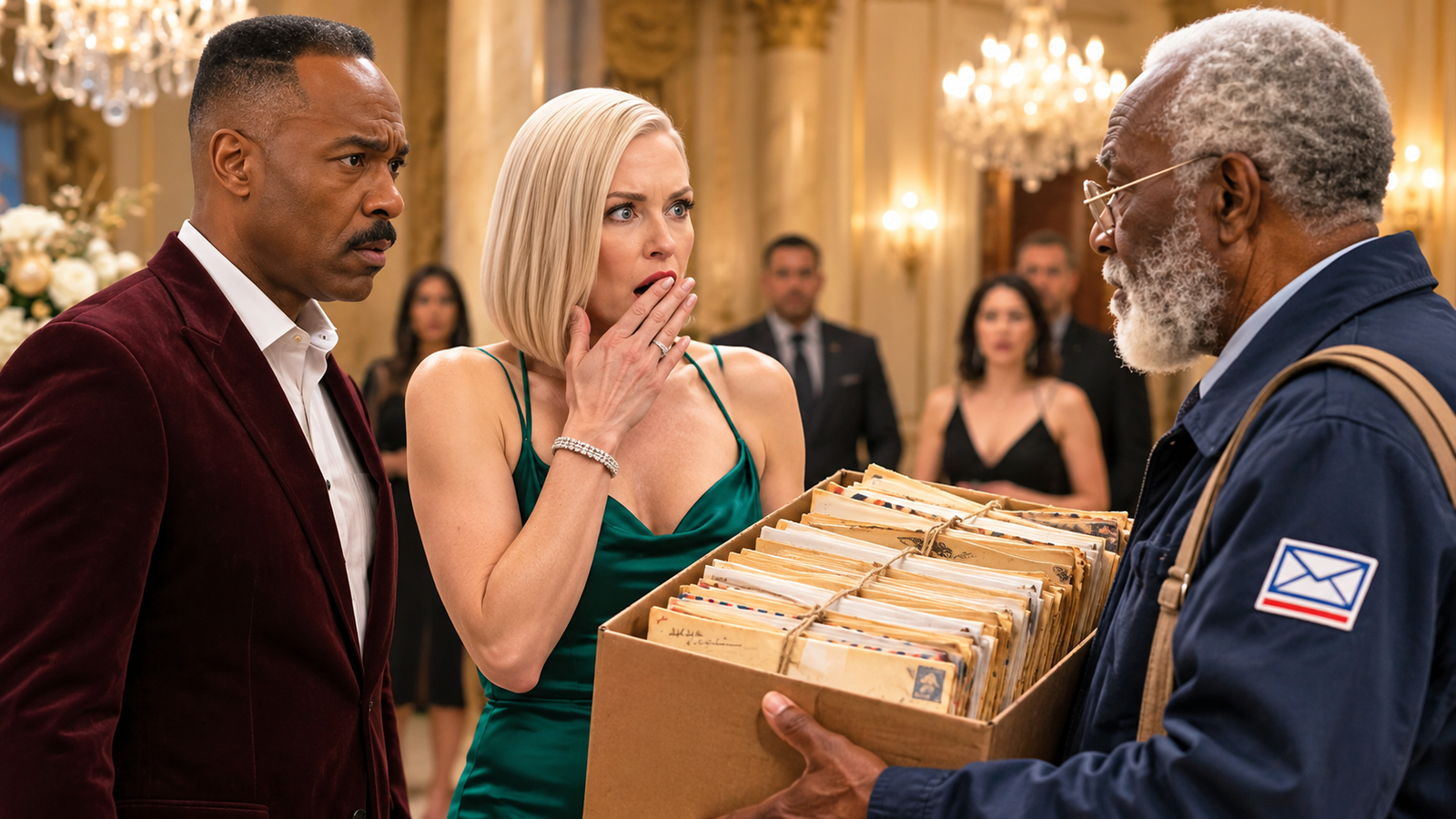
The birthday celebration stopped the moment the old postman entered.
More than two hundred guests had gathered inside the luxurious Connecticut mansion of millionaire businessman Charles Harrington.
Crystal chandeliers illuminated the enormous living room.
White-and-gold balloons decorated the ceiling.
An elegant three-tier birthday cake stood near the grand staircase.
And Charles, who was celebrating his fiftieth birthday, was surrounded by friends, business partners, and family acquaintances.
Everything looked perfect.
Until an elderly stranger appeared in the doorway.
The man wore an old navy postal jacket.
His shoulders were slightly bent.
His silver hair was neatly combed, and his face carried the deep lines of someone who had spent decades working outdoors.
In his hands was a worn cardboard box.
He walked past the surprised guests and stopped beside the birthday table.
Then he placed the box down.
“YOUR MOTHER HAS WRITTEN YOU SEVENTY-EIGHT LETTERS!”
The room fell silent.
Charles turned toward him.
“What?”
The elderly postman pointed at the box.
“Seventy-eight letters, Mr. Harrington. All addressed to you.”
Charles stared at the stranger.
He had no idea what the man was talking about.
Then his wife, Vanessa Harrington, hurried toward them.
“Who let this man inside?”
The postman turned toward her.
“Ma’am, I need to speak with your husband.”
Vanessa’s expression hardened.
“This is a private celebration.”
She pointed toward the entrance.
“Security! Get this crazy man out of my house!”
Two security employees began approaching.
But the postman remained where he stood.
“Please,” he said. “Just let Mr. Harrington see the letters.”
Charles raised one hand.
“Wait.”
The guards stopped.
Charles approached the table.
“What letters?”
The old man slowly removed the lid from the cardboard box.
Inside were dozens of yellowed envelopes.
Some had faded stamps.
Others had postal return markings.
All were addressed to Charles Harrington.
Charles picked up the first envelope.
His expression changed.
He recognized the handwriting.
The gentle curve of the letters.
The way the capital C leaned slightly to the right.
The distinctive underline beneath his name.
It was his mother’s handwriting.
“Mom?”
His voice was barely audible.
He picked up another envelope.
Then another.
Every one carried the same familiar handwriting.
Charles looked toward the old postman.
“Where did you get these?”
The man took a breath.
“My name is Henry Collins. I was a postal worker for more than forty years.”
Charles frowned.
Henry continued.
“I knew your mother. She asked me to help her get these letters to you.”
Charles stared at the box.
“That’s impossible.”
Henry looked confused.
“Why?”
Charles swallowed.
“My mother hasn’t spoken to me in seven years.”
Henry shook his head.
“No, sir.”
He pointed toward the letters.
“She never stopped trying.”
Charles felt as though the floor had disappeared beneath him.
For seven years, he had believed his mother wanted nothing to do with him.
Now seventy-eight unopened letters sat in front of him.
And his wife was standing behind him, unusually silent.
The story had begun seven years earlier.
Charles Harrington had grown up in a modest home in upstate New York.
His father died when Charles was only nine years old.
After that, his mother, Margaret Harrington, raised him alone.
She worked at a grocery store during the day.
Cleaned offices during the evening.
And sometimes took weekend shifts to pay the bills.
They never had much money.
But Charles never went hungry.
His mother always made sure he had warm clothes, school supplies, and the chance to pursue his dreams.
When Charles was fourteen, he told her he wanted to become a successful businessman.
Margaret smiled.
“Then work hard, sweetheart.”
Charles frowned.
“What if I fail?”
She gently touched his cheek.
“Then you try again.”
Those words stayed with him.
He studied business at university.
Started a small logistics company.
And spent the next twenty years building it into a multimillion-dollar operation.
When he became successful, the first person he wanted to thank was his mother.
He bought Margaret a beautiful house.
Paid off her debts.
And promised she would never have to work again.
For years, they remained close.
Every Sunday, Charles visited her.
Sometimes they ate breakfast together.
Other times they took long walks.
Margaret was proud of her son.
Not because he had become wealthy.
But because he had worked hard and remained kind.
Then Charles met Vanessa.
She was intelligent, charming, and socially sophisticated.
She worked in luxury property management and quickly became an important part of his life.
They fell in love.
Two years later, they married.
At first, Margaret was happy for them.
She welcomed Vanessa into the family and tried to build a warm relationship with her.
But Vanessa never felt comfortable around Charles’s mother.
She believed Margaret interfered too much.
Whenever Charles visited his mother, Vanessa became annoyed.
When Margaret called during dinner, Vanessa complained.
And when Charles asked his mother for advice, Vanessa accused him of being unable to make decisions independently.
“Charles, you’re a grown man,” she would say.
“I know.”
“Then why do you need your mother’s opinion on everything?”
Charles tried to reassure her.
“She’s just important to me.”
Vanessa never accepted that explanation.
Eventually, the disagreements became more frequent.
Then, seven years before the birthday party, Charles and Margaret had an argument.
It concerned a planned property investment.
Margaret believed Charles was taking an unnecessary financial risk.
Charles felt she didn’t understand the business.
For the first time in years, they raised their voices at each other.
“Mom, I need you to trust my judgment.”
Margaret looked hurt.
“I do trust you. I’m only worried.”
Charles shook his head.
“You always think you know what’s best.”
Margaret’s eyes filled with tears.
“I just don’t want you to get hurt.”
Charles left the house upset.
He planned to call her the following day.
But Vanessa encouraged him to wait.
“Give her some space.”
Charles reluctantly agreed.
A week later, he asked whether his mother had called.
Vanessa shook her head.
“No.”
Another week passed.
Still nothing.
Then Vanessa told Charles something that devastated him.
“Your mother called while you were out.”
Charles looked relieved.
“Really? What did she say?”
Vanessa hesitated.
“She said she’s tired of you ignoring her advice.”
Charles frowned.
“What?”
“She said she doesn’t want to talk until you learn to respect her.”
Charles was stunned.
His mother had never spoken to him that way before.
He wanted to call her immediately.
But Vanessa stopped him.
“Charles, let her calm down.”
He waited.
Days became weeks.
Weeks became months.
Eventually, Charles began believing that his mother had chosen to cut him out of her life.
But Margaret had been telling herself an entirely different story.
The day after their argument, she wrote Charles a letter.
My dear son,
I’m sorry we argued.
You have every right to make your own decisions.
I only want you to be happy.
Please call me when you’re ready.
Love, Mom.
She mailed it to his mansion.
A week later, it came back.
Stamped:
REFUSED — RETURN TO SENDER
Margaret stared at the envelope.
She couldn’t understand.
She wrote another letter.
It was returned too.
Then a third.
And a fourth.
She tried telephoning Charles.
Sometimes the calls went unanswered.
Other times someone answered and told her he was unavailable.
On several occasions, Vanessa took the call.
“Charles doesn’t want to speak to you right now,” she said.
Margaret began crying.
“Please, just tell him I love him.”
Vanessa replied coldly.
“I’ll pass along the message.”
But she never did.
Instead, she told Charles that Margaret had stopped calling.
That she was still angry.
That she wanted no contact.
And Charles believed her.
Years passed.
Margaret continued writing.
She wrote on his birthdays.
At Christmas.
On the anniversary of his father’s death.
Whenever she heard news about his business.
Or simply when she missed him.
Every letter ended with the same words.
I love you, Charles.
Please come see me.
But none of those letters reached him.
Vanessa had arranged for household staff to refuse mail addressed from Margaret, often presenting the instruction as Charles’s own request.
Some letters were turned away at the mansion.
Others were rejected through the household’s mail-handling arrangements.
The exact sequence varied, but the result was the same.
The envelopes were returned to Margaret without Charles ever seeing them.
The elderly woman believed her son was rejecting her.
And Charles believed his mother had abandoned him.
For seven years, they lived with the same heartbreak.
Neither knew the other was still waiting.
Then Margaret met Henry Collins.
Henry had been a postal worker in her neighborhood for decades.
He knew her by name.
He sometimes helped carry groceries to her porch.
And he always stopped to ask how she was doing.
One afternoon, he noticed Margaret standing beside her mailbox, crying.
“Mrs. Harrington?”
She quickly wiped her eyes.
“Oh, hello, Henry.”
“Is everything all right?”
Margaret hesitated.
Then showed him a returned envelope.
“It’s my son.”
Henry looked at the address.
“Charles Harrington?”
She nodded.
“He won’t accept my letters.”
Henry frowned.
“How long has this been happening?”
Margaret looked down.
“Years.”
Henry stared at the envelope.
Then he asked whether she had tried contacting Charles through another verified address or through someone she trusted.
Margaret explained that she’d made many attempts, but had never been able to reach him directly.
Henry listened.
Then he said quietly:
“Would you like help finding a reliable way to contact him?”
Margaret nodded through tears.
“More than anything.”
By then, Henry was approaching retirement.
He knew there were strict rules governing mail, and he couldn’t simply take possession of undelivered letters from the postal system.
Instead, he helped Margaret understand the return markings and suggested ways to verify the mailing address.
Margaret also began keeping every returned letter.
She placed them in a cardboard box.
Each envelope remained unopened.
Whenever one came back, she added it to the collection.
Eventually, Henry retired.
But he continued visiting Margaret as a family friend.
Sometimes he brought groceries.
Sometimes they shared coffee.
And sometimes she showed him the box.
“Seventy-eight,” she whispered one afternoon.
Henry looked surprised.
“Seventy-eight?”
She nodded.
“Seventy-eight letters.”
Henry gently closed the lid.
“Mrs. Harrington, have you ever spoken to Charles directly since this began?”
Margaret shook her head.
“No.”
He frowned.
“Then we still don’t know whether he’s personally refusing them.”
Margaret looked at him.
“What do you mean?”
Henry explained that a returned letter did not necessarily prove the named recipient had personally rejected it.
Someone else handling mail at the address could have refused delivery.
For the first time in years, Margaret allowed herself to hope.
A few weeks later, she saw a newspaper article announcing Charles’s upcoming fiftieth birthday celebration.
The article included a photograph of him and Vanessa outside their mansion.
Margaret stared at the picture.
Her son looked older.
There were gray hairs near his temples.
But his smile was still the same.
She carefully folded the newspaper.
Then called Henry.
“Do you think you could help me?”
Henry smiled.
“Of course.”
Margaret hesitated.
“I want Charles to have the letters.”
Henry asked:
“Would you like to go with me?”
Margaret looked down.
By then, she was living in a retirement community and found long journeys exhausting.
She was also afraid of being turned away in person.
“I don’t think I can.”
Henry understood.
She handed him the cardboard box.
“Please give these to him.”
Henry looked inside.
Dozens of letters.
Each one carefully addressed.
Each one returned.
“Are you sure?”
Margaret nodded.
“I’ve waited seven years.”
Her voice trembled.
“I just want my son to know I never stopped loving him.”
Henry promised he would try to deliver the box directly to Charles.
He contacted the mansion and requested an appointment.
But the household staff declined.
He tried again.
Still no success.
Finally, when he learned the birthday celebration would be attended by family acquaintances and guests, Henry decided to make one last attempt to deliver the letters in person.
He arrived at the mansion carrying the cardboard box.
And when the staff initially tried to turn him away, he insisted that the contents were important personal correspondence entrusted to him by Charles’s mother.
Eventually, he reached the reception hall.
Just as Charles was preparing to cut his birthday cake.
Now, standing before hundreds of guests, Henry watched Charles examine the letters.
The millionaire’s hands were trembling.
He opened the first envelope.
Inside was a letter dated seven years earlier.
He read the first line.
My dear Charles,
I’m sorry about our argument.
I love you, and I hope we can talk soon.
Charles froze.
He read the words again.
Then he opened another envelope.
Happy birthday, sweetheart.
I hope you’re happy and healthy.
I miss you.
Charles felt tears gathering in his eyes.
Another letter.
I saw your company’s new building in the newspaper.
I’m so proud of you.
Another.
I made your favorite apple pie today.
I wish you had been here to share it.
Charles lowered himself into a chair.
His mother had been writing to him.
For seven years.
She had never abandoned him.
She had never stopped caring.
And every letter had been returned.
He looked toward Henry.
“Why were they sent back?”
The elderly postman took a breath.
“That’s what you need to find out.”
Charles examined one of the envelopes.
The return marking clearly indicated it had been refused.
He picked up another.
The same marking.
Then another.
Again.
He looked toward Vanessa.
“Did you know about these?”
His wife stood motionless.
“Charles…”
He rose slowly.
“Did you know my mother had been writing?”
Vanessa looked around at the guests.
“Can we discuss this privately?”
Charles stared at her.
“Answer me.”
She swallowed.
“Yes.”
A wave of whispers spread through the room.
Charles felt his stomach tighten.
“You knew?”
Vanessa lowered her eyes.
He held up one envelope.
“Then why was it returned?”
She said nothing.
Charles continued.
“Seventy-eight letters, Vanessa.”
His voice broke.
“Seventy-eight!”
Vanessa began crying.
“Charles, please.”
He stared at her.
“Tell me what happened.”
Finally, she whispered:
“I told the staff not to accept them.”
For a moment, Charles couldn’t speak.
“What?”
Vanessa covered her face.
“I told them you didn’t want to hear from your mother.”
Charles stepped backward.
“Why?”
She looked up, crying.
“Because she was always interfering!”
Charles stared at her.
“Interfering?”
“She always made you feel guilty whenever you disagreed with her!”
He shook his head.
“So you decided I shouldn’t speak to her?”
Vanessa’s voice trembled.
“I thought if she stayed out of our marriage, things would be better.”
Charles looked at the letters.
“She was my mother.”
Vanessa began sobbing.
“I know.”
“No,” Charles whispered.
“You don’t.”
He raised one of the envelopes.
“She wrote to me when she was lonely.”
Another.
“When she missed me.”
Another.
“When she was proud of me.”
His eyes filled with tears.
“And I never answered because I never knew.”
Vanessa reached toward him.
“Charles, I’m sorry.”
He stepped away.
“You told me she didn’t want to see me.”
Vanessa lowered her head.
“And you told her I didn’t want to see her.”
She said nothing.
Charles felt a pain deeper than anything he had ever experienced.
For seven years, he had believed his mother rejected him.
He had missed Christmases.
Birthdays.
Family dinners.
Small moments.
Ordinary conversations.
For seven years he could never get back.
He looked at Vanessa.
“You took seven years of my mother’s love and turned it into silence.”
She began crying harder.
But Charles couldn’t listen anymore.
He looked toward Henry.
“Where is she?”
Henry smiled sadly.
“She’s at Rosewood Retirement Residence.”
Charles immediately took out his phone.
He called the residence.
After explaining who he was and confirming that Margaret was available to speak, he was connected to her.
The call rang.
Once.
Twice.
Then a familiar voice answered.
“Hello?”
Charles covered his mouth.
“Mom?”
There was silence.
Then Margaret whispered:
“Charles?”
His voice broke.
“It’s me.”
Margaret began crying.
“Oh, my boy…”
Charles sank into the chair.
“Mom, I didn’t know.”
She sounded confused.
“Didn’t know what?”
“Your letters.”
Margaret stopped speaking.
“I never got them.”
For several seconds, only her crying could be heard.
Then she whispered:
“I thought you didn’t want to hear from me.”
Charles shook his head, tears streaming down his face.
“No, Mom.”
He took a breath.
“I thought you didn’t want to see me.”
Margaret began sobbing.
“Oh, sweetheart…”
Charles closed his eyes.
“I’m coming to see you.”
“Really?”
“Right now.”
He ended the call.
Then turned toward the guests.
“I’m sorry, everyone. The party is over.”
Nobody protested.
Charles picked up the cardboard box.
And left.
Henry accompanied him to the car.
During the drive, Charles kept opening letters.
Some were short.
Some were several pages long.
Some contained old photographs.
One held a small birthday card.
Another contained a handwritten recipe.
Every letter was a reminder of time he had lost.
He looked toward Henry.
“Why did you do this?”
Henry frowned.
“Do what?”
“Bring the letters.”
The elderly postman smiled.
“Because your mother asked me.”
Charles shook his head.
“You could have walked away.”
Henry looked out the window.
“I’ve delivered mail for most of my life.”
He paused.
“But some messages matter too much to leave undelivered.”
Charles felt his eyes filling again.
“Thank you.”
Henry nodded.
“You’re welcome.”
When they arrived at Rosewood Retirement Residence, Charles hurried inside.
A staff member guided him toward the garden lounge.
Margaret was sitting near a window.
She wore a soft lavender cardigan.
Her silver hair was neatly pinned back.
She looked smaller than Charles remembered.
Older.
More fragile.
But when she lifted her head, he recognized her immediately.
“Mom?”
Margaret turned.
For a moment, she simply stared.
Then tears filled her eyes.
“Charles?”
He walked toward her.
She stood carefully.
And he wrapped his arms around her.
The two held each other as though they were afraid to let go.
Margaret began crying.
“I thought you hated me.”
Charles shook his head against her shoulder.
“No, Mom.”
His voice broke.
“I thought you’d forgotten me.”
She held him tighter.
“Never.”
For several minutes, neither spoke.
They didn’t need to.
Seven years of silence had ended.
Eventually, Charles helped his mother sit down.
He placed the box of letters on the table.
“I brought these.”
Margaret touched the cardboard lid.
“My letters?”
He nodded.
“All seventy-eight.”
Her eyes filled with tears.
“Did you read them?”
“Some.”
He took her hand.
“And I’m going to read every single one.”
Margaret smiled through her tears.
Charles looked toward Henry.
The elderly postman stood quietly near the doorway.
Charles smiled.
“Come sit with us.”
Henry hesitated.
“This is family time.”
Charles shook his head.
“You’re the reason we’re together.”
Henry slowly approached.
And the three sat together beside the window.
For the first time in seven years, Charles and Margaret talked.
They spoke about old memories.
The small house where Charles grew up.
His father’s jokes.
His mother’s cooking.
The business he had built.
And everything that had happened during the years they were apart.
Charles apologized for not trying harder to contact her directly.
Margaret apologized for the argument that had started the distance between them.
But neither blamed the other for the deliberate deception.
They both understood how completely their communication had been controlled.
Over the following weeks, Charles separated from Vanessa and began working with legal counsel to address their marriage and household arrangements.
He no longer trusted her to handle his family’s communications.
He changed his contact information where needed, established direct communication with his mother, and made sure personal correspondence would reach him without interference.
He also began visiting Margaret every Sunday.
Just as he had before.
Sometimes they had breakfast.
Sometimes they walked through the retirement residence gardens.
And sometimes they sat quietly together, enjoying each other’s company.
Charles stopped measuring those afternoons by how much work he could accomplish.
He had already learned what it felt like to lose years that could never be replaced.
One Sunday, Margaret brought him a small envelope.
Charles smiled.
“Another letter?”
She nodded.
“This one’s different.”
He opened it.
Inside was a birthday card.
The front read:
TO MY SON.
Charles looked up.
“Mom, my birthday was weeks ago.”
Margaret smiled.
“I know.”
He opened the card.
Inside, she had written:
My dear Charles,
For seven years, I wrote letters hoping one day you’d read them.
This year, I finally get to tell you how much I love you in person.
Happy birthday, sweetheart.
Love, Mom.
Charles began crying.
Margaret reached across the table.
“Oh, don’t cry.”
He laughed through his tears.
“I’m happy, Mom.”
She smiled.
“Good.”
He squeezed her hand.
Then he looked toward the cardboard box resting on a nearby shelf.
Seventy-eight letters.
Seventy-eight attempts to reconnect.
Seventy-eight reminders that love had never disappeared.
It had only been hidden.
The millionaire thought his mother had abandoned him. But for seven years, she had been trying to find a way back into his life — one letter at a time.
End of fictional story.