A Widow Found Her Dead Husband’s Name on a Stranger’s Boarding Pass — But She Buried Him Six Weeks Ago!
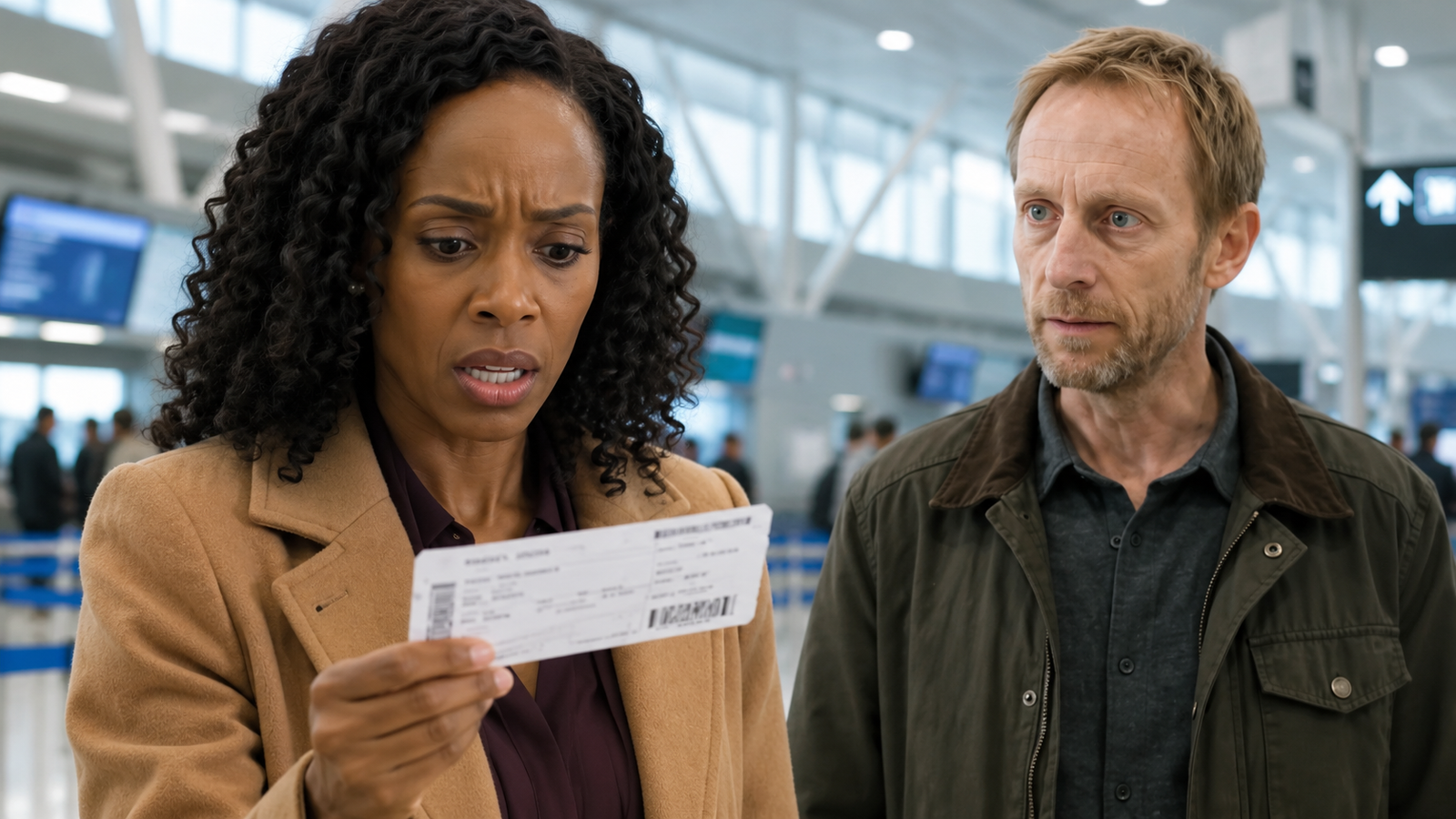
The boarding pass slipped from the stranger’s hand and landed beside a black suitcase.
Thirty-nine-year-old Rachel Morgan bent down to pick it up.
“Excuse me,” she called. “You dropped this.”
The man turned.
He looked about forty-five, wearing a dark jacket and carrying a small travel bag.
He seemed unusually nervous.
Rachel glanced at the boarding pass.
Then froze.
Printed across the top was a familiar name.
DAVID MORGAN.
Her husband’s name.
The name she had seen engraved on a gravestone six weeks earlier.
Rachel stared at the paper.
There had to be a mistake.
Perhaps it was another man with the same name.
But the coincidence was almost impossible to accept.
Her husband, David Morgan, had died suddenly at forty-three.
She had attended his funeral.
She had watched his coffin being lowered into the ground.
And now, standing inside a busy airport terminal, she was holding a boarding pass issued under his full name.
The stranger stepped forward.
“That’s mine.”
Rachel looked up.
“Excuse me… whose ticket is this?”
“Mine. Give it back.”
She held it closer.
“Then why does it have my husband’s name on it?”
The stranger’s expression changed.
For a moment, he didn’t speak.
Then he looked toward the check-in counters.
“I don’t know what you’re talking about.”
Rachel felt her heart pounding.
“David Morgan.”
The man’s eyes moved toward the boarding pass.
“That’s my name.”
Rachel shook her head.
“No.”
The stranger frowned.
“Lady, I don’t have time for this.”
Her voice began trembling.
“My husband was David Morgan.”
The man reached toward the ticket.
Rachel stepped back.
“And I buried him six weeks ago.”
The stranger froze.
Then he grabbed his suitcase handle and turned away.
Rachel called after him.
“WAIT!”
Several travelers looked toward them.
The man continued walking.
Rachel hurried to a nearby airport employee.
“Please. I need help.”
The employee noticed her distress and contacted airport security.
Two officers approached the man near the public check-in area and asked to speak with him.
He appeared reluctant but stopped.
Rachel stood several feet away, gripping the boarding pass.
One officer asked her what had happened.
She explained that the traveler’s ticket displayed the name of her deceased husband.
The officer listened carefully.
Then asked:
“Do you have anything that confirms your husband’s identity?”
Rachel opened her handbag.
She carried a copy of David’s death certificate because she was traveling to meet an attorney handling his estate.
She showed the officer the document.
The name matched.
The stranger watched silently.
The officer turned toward him.
“Sir, we’ll need to verify your identity with the airline and the appropriate authorities.”
The man’s face grew pale.
He glanced toward the terminal doors.
Then lowered his eyes.
Rachel felt something was terribly wrong.
But the boarding pass was only the beginning.
Six weeks earlier, Rachel’s life had fallen apart.
David Morgan had been her husband for fourteen years.
They met while studying business administration.
He was ambitious, thoughtful, and unusually meticulous with numbers.
After several years working in finance, he started a business with his longtime friend, Nathan Caldwell.
The company, Morgan & Caldwell Investments, initially handled commercial property acquisitions and business consulting.
Over time, it grew into a successful financial services operation managing substantial assets.
David handled accounting and financial oversight.
Nathan focused on clients and business development.
They had known each other for nearly twenty years.
David trusted Nathan.
Rachel trusted him too.
He attended family dinners.
Celebrated holidays with them.
And was considered almost part of the family.
But shortly before David’s death, something changed.
David became withdrawn.
He spent long evenings examining financial records.
Sometimes he worked until after midnight.
When Rachel asked what was wrong, he simply said:
“There’s something at the company I need to understand.”
One evening, she found him sitting alone in his study.
He was staring at a spreadsheet.
“David?”
He looked up.
“Hey.”
“Are you okay?”
He hesitated.
“I found some transactions that don’t make sense.”
Rachel sat beside him.
“What kind of transactions?”
“Large transfers involving accounts I don’t recognize.”
“Could it be an accounting mistake?”
David shook his head.
“Not this many.”
He closed the laptop.
“I need to speak with Nathan.”
Rachel remembered the concern in his eyes.
She also remembered asking him whether he wanted legal advice.
David nodded.
“If the records don’t match, I’m going to have someone independent review them.”
Two days later, David died.
He suffered a sudden medical emergency while traveling for a business meeting.
The family was told his death resulted from a serious natural health event.
The medical and identification records established that David had died.
Rachel attended the funeral in a state of shock.
Nathan stood beside her throughout the service.
He helped with some company arrangements.
He reassured Rachel that the business would continue operating.
And he promised to protect David’s professional reputation.
But after the funeral, Rachel noticed unusual things.
David’s laptop was missing from his home office for several days before being returned.
Some files appeared to have been accessed.
And his passport, normally kept inside a locked document drawer, had disappeared.
At first, Rachel assumed she had misplaced it while organizing his belongings.
She searched the house.
The garage.
His briefcase.
Every drawer.
Nothing.
She contacted the relevant authorities to report the missing passport.
But she had no reason to believe it was connected to a crime.
Then, three weeks after the funeral, Nathan stopped returning her calls.
His office said he was traveling.
His personal phone went straight to voicemail.
Several company employees reported that he had not attended scheduled meetings.
Soon afterward, the business discovered that millions of dollars were missing from accounts under investigation.
Rachel felt sick.
David had been reviewing suspicious transfers before his death.
Now his business partner had disappeared.
And the company’s financial records contained increasingly troubling irregularities.
Rachel hired an independent attorney to help protect David’s estate and understand the situation.
She had been traveling to meet with specialists when she encountered the stranger at the airport.
A chance moment.
A dropped ticket.
And her dead husband’s name.
At the airport, officers questioned the traveler in a private interview area.
His verified identity was not David Morgan.
He was a forty-six-year-old man named Eric Lawson.
When asked why his boarding pass carried another person’s name, Eric initially refused to answer.
But after investigators examined the travel records, he admitted he had obtained documents under the name David Morgan through an illicit online intermediary.
He claimed he had been promised money to travel under the false identity.
He said he had never met the real David Morgan.
Rachel watched from a separate waiting area as investigators continued their work.
She was overwhelmed.
Someone had taken her dead husband’s identity.
But why?
Later that afternoon, an investigator spoke with her.
“Mrs. Morgan, your husband’s passport was reported missing.”
“Yes.”
“We’re examining whether the missing document is connected to this travel arrangement.”
Rachel swallowed.
“Who gave that man David’s identity?”
“We’re still determining that.”
“Was someone trying to leave the country using my husband’s name?”
“That is one of the possibilities we’re investigating.”
Rachel looked toward the glass doors.
For the first time, she began wondering whether David’s death had been used as part of a larger scheme.
The investigation soon expanded.
Authorities reviewed the relevant travel-booking records and communications through lawful procedures.
They discovered that the reservation had been created using an email account associated with Morgan & Caldwell Investments.
The email account was connected to Nathan Caldwell.
Rachel felt her stomach drop when she heard his name.
“Nathan?”
The investigator nodded.
“We’re examining his involvement.”
She shook her head.
“He was David’s best friend.”
The investigator continued.
“Your husband’s identity appears to have been used in several suspicious financial activities after his death.”
Rachel stared at him.
“What?”
Records showed that company transactions had been authorized using David’s credentials after the date on his death certificate.
The transactions involved substantial sums of money.
Some were connected to accounts associated with entities under Nathan’s control.
Rachel felt dizzy.
“David couldn’t have authorized those.”
“Exactly.”
The investigators agreed.
They were examining whether someone had deliberately used the deceased man’s credentials to disguise the transactions and falsely attribute responsibility to him.
The evidence was disturbing.
David had questioned missing funds before his death.
Then he died.
Afterward, transactions continued under his identity.
And Nathan, the business partner who had access to many of the company’s systems, disappeared.
The false boarding pass appeared to be part of the same pattern.
Investigators discovered that Nathan had been arranging financial movements and travel plans connected to the missing company money.
The booking under David’s name was linked to a network of communications involving people acting on Nathan’s instructions.
Eric Lawson had been one of those people.
He was not David.
He was a stranger whose travel had been arranged using David’s stolen identity.
The investigators also determined that Nathan had been attempting to distance himself from the company’s financial misconduct.
By attributing transactions to David after his death, Nathan hoped to confuse investigators and shift suspicion toward the deceased partner’s accounts and records.
The plan was cruel.
It targeted a man who could no longer defend himself.
And it threatened to leave Rachel with a legacy of suspicion surrounding her husband’s name.
But Rachel remembered the financial records David had been examining before he died.
She returned home and searched through his remaining papers.
Inside a locked file cabinet, she found a folder labeled:
FINANCIAL REVIEW — CONFIDENTIAL
She opened it.
There were transaction summaries.
Copies of invoices.
Notes identifying inconsistencies.
And a handwritten list of questions David intended to raise with the company’s auditors.
Rachel recognized his handwriting immediately.
At the bottom of one page, David had written:
Need independent review. Do not approve these transfers until verified.
Rachel sat down.
Tears filled her eyes.
David had been trying to uncover the truth.
He hadn’t been participating in the suspicious transactions.
He had been documenting them.
Rachel contacted her attorney.
The records were preserved and provided to investigators through the appropriate process.
A forensic accounting review confirmed that the material was relevant to the suspected fraud.
The investigators compared David’s notes with the company’s transaction history.
They identified discrepancies between the genuine records and documents later used to implicate him.
Additional evidence connected Nathan to unauthorized transfers and the misuse of David’s identity.
The case against the former business partner grew stronger.
Authorities began tracing the missing funds and identifying the associates who had helped arrange the fraudulent activities.
Eric cooperated after receiving legal advice.
His statements helped investigators identify communications and arrangements connected to Nathan’s attempted escape.
Eventually, investigators located Nathan.
He was detained as the investigation advanced.
Rachel was later informed that he faced serious allegations involving financial fraud, identity misuse, and related offenses.
But one question continued to haunt her.
Had Nathan been responsible for David’s death?
Investigators carefully reviewed the available medical and circumstantial evidence.
They found no reliable basis to conclude that David’s natural death had been caused by Nathan.
The known evidence supported the financial conspiracy and identity theft, not a homicide allegation.
That distinction mattered to Rachel.
She wanted the truth.
Not speculation.
And the truth was already devastating enough.
Nathan had exploited David’s death.
He had used a dead man’s identity.
Manipulated company records.
And attempted to redirect suspicion away from his own misconduct.
For weeks, Rachel had feared that David’s reputation would be destroyed.
Now she could finally begin defending it.
Several months later, the company’s financial investigation produced a more complete picture.
David’s records helped establish that he had questioned the suspicious transfers before he died.
The posthumous transactions had not been legitimately authorized by him.
The accounts connected to the misconduct were subject to further legal and financial proceedings.
Rachel worked with her attorney to ensure the estate was not wrongly held responsible for actions taken after David’s death.
The criminal case continued through the courts.
But the evidence had already changed how the company understood David’s final weeks.
He had not been hiding wrongdoing.
He had been trying to expose it.
One afternoon, Rachel visited David’s grave.
She carried a small bouquet of white flowers.
The cemetery was quiet.
She placed the flowers beside the headstone.
Then sat on the grass.
“Hi, David.”
Her voice trembled.
For several moments, she said nothing.
Then she smiled sadly.
“I found your notes.”
She looked down at the documents in her hands.
“You were right. Something was wrong.”
Tears ran down her cheeks.
“They tried to make it look like you were responsible.”
She took a breath.
“But we found the truth.”
A light breeze moved through the trees.
Rachel closed her eyes.
For weeks, she had been grieving the man she loved.
And fighting to understand why his name had appeared in records that made no sense.
Now, finally, she could begin letting go of the fear that his legacy would be stolen.
She touched the gravestone.
“You always told me that a person’s name is worth protecting.”
Her voice broke.
“I did my best.”
Rachel sat quietly for a long time.
Then she stood.
Before leaving, she looked back.
“I love you.”
Months later, Rachel attended a private gathering with several of David’s former colleagues.
They had organized a tribute to his work and integrity.
One employee approached her.
“Mrs. Morgan?”
She turned.
“Yes?”
“I worked with David for almost ten years.”
Rachel smiled faintly.
“He was a good man.”
The employee nodded.
“He was.”
Then he added:
“When I heard about the financial investigation, I wanted you to know something.”
Rachel looked at him.
“David was the first person who questioned those transactions.”
Her eyes filled with tears.
“He didn’t ignore them.”
The employee nodded.
“He cared about doing things properly.”
Rachel smiled through her tears.
“That sounds like him.”
Later that evening, she returned home and opened an old photograph album.
There were pictures from their wedding.
Vacations.
Birthdays.
Ordinary days they had spent together.
She stopped at a photograph of David laughing beside their kitchen table.
For a moment, she could almost hear his voice.
Rachel gently touched the picture.
The stolen identity had been exposed.
The fraudulent records had been challenged.
And the man who tried to exploit David’s death was facing the consequences through the legal process.
But none of it could bring David back.
Rachel understood that.
Still, she had protected something precious.
His name.
His work.
And the truth about the person he had been.
A widow found her dead husband’s name on a stranger’s boarding pass. What she uncovered was not proof that her husband was alive — but proof that someone had been using his death to hide a crime.
End of fictional story.