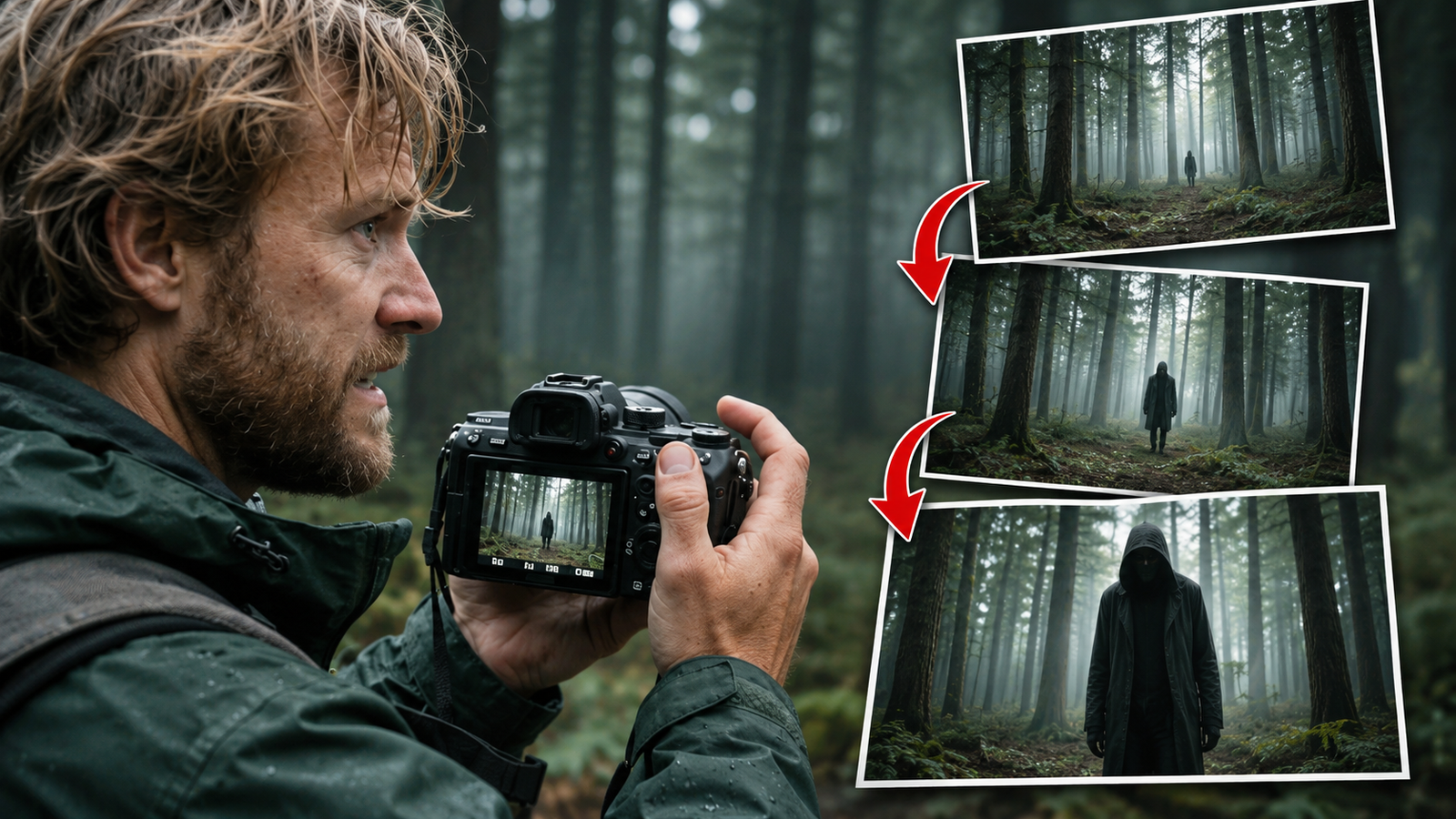
A Photographer Took a Picture of an Empty Forest — But Something in Every Photograph Was Getting Closer!
Lucas Bennett had photographed some of the most isolated places in North America.
He had spent nights alone in the mountains of Montana, tracked wildlife through remote Canadian forests and waited for hours in freezing temperatures to capture photographs of rare animals.
At thirty-six, he considered himself an experienced wilderness photographer.
He understood the dangers of working alone.
Wild animals.
Unpredictable weather.
Getting lost.
But nothing could have prepared him for what appeared on his camera screen that afternoon.
Because whatever was following Lucas through Blackridge Forest couldn’t be seen with the human eye.
And every photograph brought it closer.
The Forest Nobody Photographed
Blackridge Forest occupied thousands of acres of isolated wilderness in northern Washington.
Its enormous pine trees blocked much of the daylight, creating an almost permanent atmosphere of twilight beneath their branches.
Lucas had traveled there to photograph a rare species of owl reportedly seen near an abandoned forestry station.
Before entering the forest, he stopped at a small roadside convenience store.
An elderly man behind the counter noticed his camera equipment.
“Going into Blackridge?”
Lucas nodded.
“Just for the afternoon.”
The man looked at the camera hanging around Lucas’s neck.
“You taking pictures in there?”
“That’s the plan.”
The elderly man remained silent for a moment.
Then he said something Lucas would remember for the rest of his life.
“If you photograph something you can’t see, don’t take another picture.”
Lucas smiled politely.
He assumed it was some local superstition intended to frighten tourists.
He purchased a bottle of water, returned to his vehicle and continued toward the forest.
Less than two hours later, he would desperately wish he had listened.
The First Photograph
At approximately three in the afternoon, Lucas stopped along a narrow forest trail.
A thin layer of fog had settled between the trees.
The light was perfect.
He raised his digital camera and photographed the empty woodland.
The shutter clicked.
Lucas lowered the camera and examined the image.
At first, everything appeared normal.
Tall pine trees.
Damp ground.
Patches of moss.
A narrow trail disappearing into the fog.
Then he noticed something.
Between two distant trees stood a human figure.
It was unusually tall.
Its arms hung motionless beside its body.
It appeared to be wearing a long, dark coat.
Lucas enlarged the photograph.
The figure’s face was completely obscured by shadow.
He looked up.
“Hello?”
Nobody answered.
Lucas stared toward the trees where the figure should have been standing.
There was nothing there.
He checked the photograph again.
The figure was still visible.
The Second Photograph
Lucas assumed someone had moved behind a tree.
Perhaps another photographer.
Perhaps a hiker who hadn’t noticed him.
He raised his camera and photographed the exact same location.
The shutter clicked.
Lucas examined the new image.
His stomach tightened.
The figure was still there.
But it was no longer standing between the distant trees.
It was considerably closer.
Lucas compared the photographs.
In the first image, the figure appeared approximately forty meters away.
In the second, it appeared less than twenty meters away.
Its posture hadn’t changed.
Its arms remained perfectly straight.
Its face was still hidden.
Lucas looked directly ahead.
The forest was empty.
He could hear the wind moving through the branches.
Nothing else.
No footsteps.
No breathing.
No movement.
He suddenly remembered the elderly man’s warning.
If you photograph something you can’t see, don’t take another picture.
Lucas slowly lowered his camera.
The Third Photograph
For nearly a minute, Lucas stood completely still.
He tried to convince himself that the photographs contained some kind of digital error.
Perhaps a damaged image sensor.
Perhaps an unusual reflection inside the lens.
He had encountered photographic abnormalities before.
There had always been an explanation.
He decided to take one final picture.
The shutter clicked.
Lucas looked at the screen.
The figure was now standing approximately five meters away.
Its dark clothing was clearer.
Its body appeared unnaturally narrow.
Its head was tilted slightly toward him.
Lucas immediately looked up.
Nothing.
He backed away.
His breathing became shallow.
Then he noticed another disturbing detail.
The figure’s shadow was visible across the forest floor in the photograph.
But when Lucas looked at the actual ground, there was no shadow.
He switched off his camera.
And began running.
The Cabin
Lucas followed the trail back toward his vehicle.
At least, he believed he was following the correct trail.
The forest looked different now.
The fog had become thicker.
Several fallen trees blocked his route.
His phone displayed no signal.
The navigation application couldn’t establish his location.
Lucas continued moving until he noticed a structure through the trees.
An abandoned wooden cabin.
Its roof was covered in moss.
Several windows had been boarded shut.
The front door stood partially open.
Lucas approached cautiously.
“Hello? Is anybody here?”
There was no response.
He entered and pushed the door closed behind him.
The interior smelled of damp wood and dust.
A rusted stove stood in one corner.
An old mattress rested against the wall.
A long wooden table occupied the center of the room.
Lucas approached it.
Then stopped.
The table was covered with cameras.
The Missing Photographers
There were dozens of them.
Modern digital cameras.
Old film cameras.
Instant cameras.
Professional photography equipment.
Some appeared to have been sitting there for decades.
Others looked relatively new.
Camera bags were stacked beneath the table.
Memory cards, batteries and handwritten notebooks lay scattered across its surface.
Lucas picked up one of the bags.
A small identification tag was attached to its handle.
DANIEL FOSTER — WILDLIFE PHOTOGRAPHER.
Lucas recognized the name.
Daniel Foster had disappeared while photographing wildlife in Washington three years earlier.
His disappearance had received considerable attention within the photography community.
Search teams had never located him.
Lucas examined another bag.
RACHEL MORGAN.
He remembered her too.
A landscape photographer who had disappeared the previous autumn.
Her vehicle had been discovered near Blackridge Forest.
Her equipment had never been recovered.
Until now.
Lucas stepped backward.
These cameras didn’t belong to people who had abandoned their equipment.
They belonged to people who had never returned home.
The Final Photographs
Lucas selected a digital camera from the table.
Its battery was dead.
He tried another.
Nothing.
The fourth camera switched on.
Lucas opened its image gallery.
The first photographs showed ordinary woodland scenery.
Then he noticed a familiar shape.
A tall, dark human figure standing between two trees.
He advanced to the next photograph.
The figure was closer.
The next image showed it standing near the photographer.
Lucas continued scrolling.
The final photograph had been taken inside the cabin.
The figure stood directly beside the wooden table.
Lucas dropped the camera.
He looked toward the table.
The cabin was empty.
He picked up another camera and examined its photographs.
The same figure appeared.
The same dark clothing.
The same obscured face.
The same impossible progression.
Every photograph brought it closer.
And every photographer had eventually reached this cabin.
The Notebook
Beneath a pile of camera straps, Lucas discovered a weathered notebook.
Its cover was damaged by moisture.
Inside were handwritten entries from different people.
Some were dated decades earlier.
Others had been written recently.
The first readable entry belonged to a photographer named William Carter.
October 12, 1978.
I saw it in the photograph. Margaret says there was nothing standing there.
The next entry read:
It appears closer every time.
Several pages later, another person had written:
I thought destroying the camera would stop it. I was wrong.
Lucas continued turning the pages.
One entry had been written in large, uneven handwriting.
THE CAMERA DOESN’T CREATE IT.
THE CAMERA SHOWS YOU WHERE IT IS.
Another entry contained a warning.
Don’t assume you’re safe just because you can’t see it.
Lucas looked around the cabin.
For the first time, he wondered whether the figure was already inside with him.
The Camera That Turned Itself On
Lucas placed his own camera on the wooden table.
He had switched it off before entering the cabin.
Its screen was completely dark.
He began searching the room for another exit.
Then he heard a familiar electronic sound.
His camera had switched itself on.
Lucas turned.
The screen illuminated.
He approached slowly.
Before he could touch it, the shutter clicked.
Lucas froze.
He picked up the camera.
The photograph showed the cabin’s interior.
The wooden table.
The old mattress.
The boarded window.
And Lucas himself.
He was standing near the cabin door, facing away from the camera.
Directly behind him stood the figure.
Its head was lowered toward his shoulder.
Its long arms hung beside his body.
It was close enough to touch him.
Lucas stared at the image.
Then slowly turned around.
There was nobody there.
The Photograph Taken From Behind
Lucas struggled to breathe.
He looked at the photograph again.
Something about it was wrong.
The camera had been sitting on the wooden table.
Yet the photograph appeared to have been taken from a position near the ceiling.
The angle was impossible.
He examined the image more closely.
The figure’s face was partially visible.
It wasn’t entirely featureless.
There appeared to be something beneath the shadow.
Something resembling a human face.
Lucas enlarged the image.
His hands began trembling.
The figure looked like Daniel Foster.
The missing wildlife photographer.
Lucas immediately retrieved Daniel’s identification tag.
A small photograph was attached to the back.
The resemblance was unmistakable.
The same narrow jaw.
The same hairline.
The same prominent cheekbones.
But the face in Lucas’s photograph looked distorted and exhausted.
As though Daniel had been trapped somewhere for a very long time.
The People Inside the Pictures
Lucas returned to the other cameras.
He began examining the mysterious figure in each photographer’s final images.
The faces were difficult to distinguish.
But whenever the figure appeared close enough, its appearance seemed to change.
In one photograph, it resembled an elderly man.
In another, a woman.
In another, a young photographer wearing a familiar jacket.
Lucas looked at Rachel Morgan’s camera.
Its final photograph showed a tall figure standing outside the cabin.
The figure’s face resembled another photographer whose equipment rested on the table.
Lucas began to understand.
Perhaps the figure wasn’t a single entity.
Perhaps it was something that used the appearances of the people who had disappeared.
Or perhaps those people had become part of it.
He returned to the notebook.
Near the final pages, he discovered an entry written by Daniel Foster.
I thought it was hunting me.
Now I think it wants me to see something.
Every time I take a picture, the distance between us becomes smaller.
But I don’t think it’s the one moving.
Lucas read the final sentence repeatedly.
What did Daniel mean?
The Forest Inside the Photograph
Lucas examined his first photograph again.
The figure stood between two distant pine trees.
He opened the second image.
Then the third.
He noticed something he had overlooked.
The trees were changing.
In the first photograph, the forest appeared exactly as he remembered it.
In the second, several trees were positioned differently.
In the third, the trail behind the figure had disappeared.
Lucas compared the photographs with his memory of the actual forest.
The figure wasn’t simply approaching.
The entire photographed environment was changing.
He looked at the cabin photographs.
In one image, the cabin contained an intact window.
In another, the wooden table stood in a different location.
In another, the walls appeared freshly constructed.
The photographs seemed to depict different versions of the same place.
Different moments.
Different realities.
Lucas returned to Daniel’s notebook entry.
I don’t think it’s the one moving.
Perhaps the figure wasn’t approaching the photographers.
Perhaps the photographers were being pulled toward whatever world existed inside their photographs.
And every image brought them deeper into it.
The Voice Outside
A sound came from beyond the cabin door.
Footsteps.
Lucas immediately turned.
Someone knocked three times.
“Hello?”
A man’s voice.
“Is someone inside?”
Lucas remained silent.
“I’m a forest ranger. Are you lost?”
Lucas moved toward the door.
Then stopped.
He had been alone in the forest for hours.
His phone had no signal.
Nobody knew his exact location.
How had a ranger found him?
The voice continued.
“Lucas Bennett?”
Lucas stepped backward.
“How do you know my name?”
There was a long silence.
Then the voice answered.
“Your camera bag.”
Lucas looked toward his bag.
It was sitting beside the wooden table.
Inside the cabin.
The person outside couldn’t possibly have seen it.
“Open the door, Lucas.”
The voice changed.
It now sounded strangely familiar.
“It’s getting dark.”
Lucas recognized it.
It was his own voice.
The Last Entry
Lucas searched the notebook for anything that might explain how to escape.
On the final page, he discovered a message written in red ink.
STOP LOOKING FOR IT.
Beneath it was another sentence.
The forest you see through the camera isn’t the forest you’re standing in.
Don’t follow the photographs.
Follow something that exists outside them.
Lucas looked toward the boarded window.
A faint breeze entered through a gap between the wooden planks.
He could hear water flowing somewhere nearby.
He remembered crossing a shallow stream shortly after entering the forest.
The stream eventually ran beneath a small bridge near the parking area.
If he could locate the water, he might find his way back.
He left the cameras on the table.
He placed his own camera beside them.
Then he noticed something.
A small photograph was resting beneath the notebook.
It showed the elderly man from the convenience store.
He appeared much younger.
Standing beside the same cabin.
A handwritten date appeared on the back.
OCTOBER 12, 1978.
Lucas recognized the date.
William Carter’s first notebook entry.
The elderly man had been here before.
And somehow, he had escaped.
The Escape
Lucas waited until the knocking stopped.
Then he opened a damaged rear window and climbed outside.
The fog was so thick that he could barely see the trees ahead.
He followed the sound of flowing water.
Behind him, something moved through the undergrowth.
Lucas refused to turn around.
He continued walking.
The sound followed.
Occasionally, he heard what sounded like a camera shutter.
Once.
Then again.
Each time, the sound appeared closer.
Lucas kept moving.
Eventually, he reached the stream.
He followed it downstream until he recognized the small wooden bridge near the forest entrance.
His vehicle was parked beyond it.
Lucas ran toward the car.
He climbed inside, locked the doors and started the engine.
As he drove away, he glanced toward the forest in his rearview mirror.
The trees stood completely still.
There was nobody there.
The Man Who Escaped in 1978
Lucas returned to the convenience store.
The elderly man was still behind the counter.
When he saw Lucas, his expression changed.
“You took another picture.”
Lucas nodded.
“I found the cabin.”
The man slowly lowered his newspaper.
“How many cameras?”
“Dozens.”
The elderly man closed his eyes.
Lucas placed the photograph from the notebook on the counter.
“That’s you, isn’t it?”
The man examined it.
“Yes.”
His name was William Carter.
In 1978, he and his wife, Margaret, had entered Blackridge Forest to photograph the autumn landscape.
William had captured the mysterious figure.
Margaret insisted there was nothing there.
They continued taking photographs until they discovered the cabin.
Only William returned.
For nearly fifty years, he had warned photographers not to enter the forest.
Lucas asked what the figure was.
William shook his head.
“I don’t know.”
“Why did it look like the missing photographers?”
“Because they’re still there.”
Lucas stared at him.
“Inside the forest?”
William looked toward the photograph.
“Not the forest we know.”
The Photograph That Shouldn’t Exist
Authorities searched Blackridge Forest the following morning.
Lucas provided the approximate location of the cabin.
Search teams examined the area for several days.
They found no abandoned cabin.
No cameras.
No equipment belonging to the missing photographers.
Lucas was questioned repeatedly.
Without his camera, he had no photographic evidence of what had happened.
He eventually returned home.
For several weeks, he refused to take another photograph.
He sold most of his equipment.
He canceled his upcoming photography assignments.
He avoided looking at old pictures from the forest.
Then, one evening, his phone displayed a notification.
A new photograph had been uploaded to his cloud photography account.
Lucas opened it.
The image showed the interior of the abandoned cabin.
Dozens of cameras rested on the wooden table.
His own camera was among them.
Standing behind the table was the mysterious figure.
Lucas enlarged the photograph.
The face was no longer Daniel Foster’s.
It was his own.
The Final Photograph
Lucas contacted William immediately.
He explained what had appeared in his account.
William remained silent for several seconds.
Then he asked:
“Have you taken any photographs since you came home?”
“No.”
“Has anybody taken a photograph of you?”
Lucas thought about it.
His sister had visited the previous weekend.
They had taken a photograph together in his living room.
He opened the image.
At first, it appeared perfectly ordinary.
Lucas and his sister were smiling beside the fireplace.
Then he noticed something reflected in the dark television screen behind them.
A tall human figure.
Standing in the hallway.
Lucas immediately called William again.
But the elderly man didn’t answer.
The following morning, Lucas drove back to the convenience store.
It was closed.
A handwritten notice had been attached to the entrance.
William Carter had been reported missing.
His vehicle had been discovered near Blackridge Forest.
Inside was an old film camera.
Lucas returned home and deleted the photograph from his phone.
That evening, another image appeared in his account.
It showed his living room.
The fireplace.
The television.
The hallway.
The figure was no longer standing in the hallway.
It was standing directly in front of the camera.
And this time, Lucas could clearly see its face.
It was smiling.
His phone’s front-facing camera suddenly activated.
Lucas stared at the screen.
Behind his own reflection stood a tall, dark figure.
He slowly turned around.
The room was empty.
Then his phone took a photograph.
Lucas had escaped the forest.
But the thing inside the photographs had discovered how to follow him home.
End of fictional story.